•  •  •  •  •  •  •  •  •  •  •  •  •  •  •  •  •  •  •  •  •  •  •  •  •  •  •  •  •  •  •  •  •  •  •  •  •  •  •  •  •  •  •  •  
We're campaigning for a Special DVD edition of "The Night of the Hunter": Join the cause!
•  •  •  •  •  •  •  •  •  •  •  •  •  •  •  •  •  •  •  •  •  •  •  •  •  •  •  •  •  •  •  •  •  •  •  •  •  •  •  •  •  •  •  •  

Sunday, October 26, 2008

Star of the month in November at TCM (2)

Well, well... Here we have at last TCM's list of the films that lucky North Americans shall be able to watch in November, when our dear Charles shall be starring on that channel for a month.

Of these 18 films there are some unmissable by anyone who wants to know where Laughton's prestige comes from, some whose inclusion is questionable, and some which are inexplicably absent. Let's comment briefly on them.


Our lad Charles in a beautiful still taken during his early Hollywood days (Fellow Laughtonian Alceo has contributed with this wonderful 1932 picture from his collection)

Of these 18 features, we have two classics directed by Korda: his filmmaking may have become a bit dated, but Charles' performance as the Tudor king in The Private Life of Henry VIII is still the gold standard on the character (despite the recent "sexy Tudors on sweaty T-Shirt" trend), and his Rembrandt remains a sensible portrait of the struggles of a creator.

Despite recent historical revisionism depicting Captain Bligh as the hero of the story, Laughton's portrayal in Mutiny on the Bounty has connections with the real man: If the real Mr. Bligh was not the tyrant depicted in Nordhoff and Hall's novel, He was, as Laughton's Bligh, an excellent sailor (something quite forgotten in some later versions), a man isolated from his subordinates and crew, and a poor manager of human resources with an explosive temper. The real Bligh also had those bushy eyebrows ;p

Welcome are also the tyrannical Victorian father he plays in The Barrets of Wimpole Street, where he managed to manoeuvre past the Hays Code, by suggesting the more unwholesome aspects of father Barret's overprotectiveness of his daughter Elizabeth Barret, without the need of explicit dialogue. And his memorable Quasimodo in The Hunchback of Notre Dame, which he makes trascend into a powerful metaphor of human suffering.

We also have his inimitable Sir Wilfrid Robarts Witness For The Prosecution, a man seriusly concerned with Law and justice, in spite of his unlawful penchant for smuggling forbidden pleasures. We'll also see him in a court in a minor Hitchcock, The Paradine Case as a corrupt, ruthless and concupiscent judge. We also have an earlier joint effort with the master of suspense, Jamaica Inn , again, it may not be a top-notch Hitchcock, but it has a suitably dark atmosphere, and an over-the-top, and fairly enjoyable, performance by film producer Laughton.

Lesser known movies and parts, but fairly worth of re-discovery, are given a chance. Among them we have the film version of the stage success that brought Charles to Hollywood, Payment Deferred, a film which certainly lets you know that it is based on a play, but Laughton's clerk which commits murder, in spite of being quite unsuited for crime, is a fairly strong composition. There is also his supporting role, and first Hollywood work, as a Northern tycoon in James Whale's riotously bizarre The Old Dark House, which is both the paragon and the parody of the "haunted house" genre. The tropical noir The Bribe, in which he plays a small-time briber with bad feet, is a film, and a performance, worth re-discovering. And Captain Kidd may lack the lavish production values of Mutiny on the Bounty, but certainly has a strong central performance.

Surprisingly in!
As for some others, I find the TCM selection to be a bit odd at points, particularly considering that this monthly homage lacks some legendary performances, I mean, there is fun and charm in The Canterville Ghost, but it still makes you think what a film could have resulted if MGM had not watered down the original story by Oscar Wilde with circumstancial war propaganda and coarsened it with squaddy jokes (Think, for instance, in The Ghost and Mrs. Muir).

Young Bess, is posh -but not terribly exciting- costume drama, which I bet has been included to compare Laughton's performance as Henry VIII with his Oscar-winning performance of 1933. And one wonders why Salome is there: it is one of those films of the Somniferous Bible Epic genre, and not even Laughton's Herod can shake it up... I wonder why they don't show Cecil B. De Mille's The Sign of the Cross, instead: It's full of saucy pre-code naughtiness, bizarre fights at the Roman circus, and Claudette Colbert's Poppaea and Laughton's "wild Wilde Nero" (as Elsa Lanchester fittingly put it) really nail their characters (As with Henry, Laughton's Nero is pretty much the Nero to end all Neros: Peter Ustinov in Quo Vadis was like an Ursuline nun in comparison)

But when one sees that turkeys like Stand By For Action and The Man From Down Under, films only suitable for a Laughton completist (and a very hardened one,) are included in a 18-film season (out of a filmography of more than 50), the reason is clear: TCM is programming what he's got in its stock, and The Canterville Ghost, Young Bess, Stand By For Action are all MGM productions... still, how far are these from The Barrets of Wimpole Street or Mutiny on the Bounty!! The reason for this is, in his thirties' films for MGM, Laughton worked for Irving Thalberg, an intelligent producer who had more appropiate ideas as to what to do with Laughton's talent than Louis B. Mayer. I have read that Mayer kept Laughton under contract at MGM out of respect for the late Thalberg, who was a friend of Charles. Yet Mayer was evidently at a loss of what to do with Laughton, otherwise, one can't understand how he miscast him in parts like the old Aussie warrior of The Man From Down Under (a part and film Laughton woefully -and adequately- described to a friend as "You Can't Keep The Wallace Beery Tradition Down"), or the old Admiral which becomes suddenly obsessed with obstetrics in Stand By For Action, which Laughton has left no option but to play in an avant-la-lettre Monty Pythonese fashion.

Honest, rather than including these last two, I'd rather go for the rarely screened Mayflower productions Vessel of Wrath/The Beachcomber and St. Martin's Lane/Sidewalks of London , or some rather good performances of Laughton in anthology films like If I Had a Million, Tales of Manhattan, O'Henry's Full House or, why not? recover the long-lost-in-some-vault The Blue Veil.

I won't extend my criticism, however, to Abbott and Costello Meet Captain Kidd, Hey! it's an Abbot and Costello film... You won't expect something like The Seventh Seal, won't you?

Actually I think that it makes for a fun double bill with Captain Kidd, and Laughton admired Lou Costello and wanted to work with him. You may consider it a silly movie, but I don't think it's actually that harmful... If you ask me, as far as Laughton doing comedy goes, I'd rather see him in Abbott and Costello Meet Captain Kidd than in Hobson's Choice... Oh, I know this may sound blasphemous to some of you (so here I'm rushing to my artillery-proof concrete parapet), but I have to confess that my feelings about the David Lean film are quite similar to SImon Callow's, or to what Groggy Dundee says in his blog .

Surprisingly out!
Now, If I have complained about the inclusion of some films, it is because I feel they are stealing room to some really memorable performances which are let out... I suppose that the "films in stock" thing is the only explanation to that, but it still hurts that we have Stand By For Action, but lack This Land Is Mine , Island of Lost Souls , Les Miserables, Ruggles of Red Gap, The Big Clock or Advise and Consent... All I can say about that is.. ouch!.

Ouch, ouch, ouch!... And ouch!

Furthermore, Wouldn't it be a grand chance to broadcast the legendary BBC documentary The Epic That Never Was, containing tantalizing excerpts of Laughton as Emperor Claudius?

Lastly, and, understanding that the "Star of the Month" refers to actors, it wouldn't have been much of a stretch to include The Night of the Hunter? I mean, after all he could only direct that film... and then, Robert Gitt's Charles Laughton Directs The Night of the Hunter.

Oh well... It's good enough that Charles has a season of his films on TCM, but then... it could be even better!

Thursday, October 09, 2008

Being a sport

I just came across a few caricatures from Hollywood stars by Chilean artist Jorge Délano "Coke". You'll see a cartoon of Charles among them. It comes after caricatures of Bette Davis, Basil Rathbone and Ronald Colman, and I'd like to give you an approximate translation to English of the captions of those images.

"Coke" writes:

The great Bette Davis wasn't annoyed by this sketch.

Contrarely, Basil Rathbone was furious when he saw his. "I've never had such a nose!", he exclaimed indignant.

Ronald Colman was offended, too. "I'm not that old!", he grumbled. Both of them forced their drawings to be retired from the exhibition. "Where did the English sense of humour go?" I wondered.

Charles Laughton gave me the answer when he praised his caricature. He wrote the following in my album when he signed it "God forgive you! My wife says it's brilliant!"


This makes me think that much has been written about Charles dissatisfaction with his looks, and Oh, The Unhappiness About it, and blah, blah, blah...

Still, if you step down from commonplace bus, it's obvious, from this little anecdote, that Charles coped much better with a caricature of his looks, than either Ronald Colman or Basil Rathbone, who would be no doubt be regarded by the general public as more attractive, and from this story come as men rather insecure about his (better) looks.

So you see, while Charles was self-conscious about his looks, he could live with it... and he had real English sentido del humor.

Tuesday, September 30, 2008

It was thirty years ago today...


Albert Lory (Charles Laughton) and Louise Martin about to face Nazi Tiranny in "This Land Is Mine" (1943). Miss O'Hara looks gorgeous as usual, and Charlie doesn't look 'arf bad, either

Well, it was thirty years ago, on a 30th of september. I think it was saturday. There was a film titled "Esta tierra es mía" (This land Is Mine") on TV. I saw it.

While it wasn't my first Laughton movie (a few months before that I had seen -and enjoyed- "Witness for the prosecution"), this was the one which hooked me to Charles. It also made me a Renoirian. And, definitely, a cinephile.

In short, had I not watched "This Land Is Mine" that evening of September 30th in 1978, this blog wouldn't exist.

Now You know what to blame ;D

Sunday, September 21, 2008

Star of the month in November at TCM


1935. Charles, about to work in "Mutiny On The Bounty", reaches the American shores: a blessed land where one can still enjoy a season of his films on TV

Well, a fellow Laughtonian, who is a subscriber of Turner Classic Movies just told me that Charles is going to be the Star of the month in November at TCM. I've browsed the web and I've seen further mentions of it, though not in TCM USA's site, where only the current Star of the Month is featured.

This is good news for all those of you who live in the USA, for in my little corner of the Mediterranean, it seems highly unlikely that TCM Spain will programme a season of Charles' films. I fear that the thinking minds of TCM Spain are planning to do an Ed Wood season instead.

You'll tell me how it goes.

Wednesday, September 17, 2008

Another Gish experience


Miss Gish entertains a devoted fan

During his final illness, Charles Laughton was dictating to Bruce Zortman (1) what was meant to be an autobiography, but which remained unfinished due to Laughton's death. Elsa Lanchester reported how one day she entered in the room. Charles was asleep due to the medication, and Zortman showed the notes he had taken during that day. In Zortman's notebook there was just this one sentence: "I was in love with Lillian Gish".

The young Laughton was certainly impresed with Lillian Gish. He would say that, shortly after the 1918 armistice (2) he was struck by Miss Gish acting in "Broken Blossoms" , and would see the film "over and over again" (2). Years later, during the preparation of "The Night of the Hunter" he saw old silent films by David Wark Griffith, he would meet Miss Gish again, and he offered her the part of Rachel Cooper. Liking the script, she eventually agreed to play it, and the Silent film star and her fan would work together happily.

After the New York première, Laughton sent this affectionate letter to Lillian Gish (3):

Dear Little Iron Butterfly,

Even though I talked to you yesterday I feel compelled to write you a note to tell you further that I think you are the living end. The reviews in New York, as you have now discovered, were wonderful for you--
And from all over the country I keep getting wires and calls, and everyone is unanimous in their praise for you.

I am happy to have had another Gish experience, and as long as I shall live and be active I hope that my life, professionally as well as personally, shall have a lot of Gish in it.

So, you see, these are my roses and carnations -- and they are just as sweet as you are.

Love,


It is sad, in retrospect, not to feel sad when reading this letter, knowing what the future had in store for Charles' career as a director.

Shortly after the release of "The Night of the Hunter", Laughton and Gish would be briefly together in a TV programme produced by Paul Gregory, "The Day Lincoln Was Shot", in which some members of the cast and crew of "The Night of the Hunter" would be working as well. Laughton was the narrator of the story and Lillian Gish played Mary Todd (curiously, John Wilkes Booth was played by a young Jack Lemmon). This programme was an hiatus in the work which Laughton and the Sanders brothers were dpoing in the script of "The Naked And The Dead". This work was never resumed: in the meantime, "The Night of the Hunter" failed at the box-office. Laughton and Gregory split their partnership. Laughton would never directed again, would never have the chance of working again with Lillian Gish.

Dorothy and the Wolves

In between "Broken Blossoms" and "The Night of the Hunter", Charles was to have another Gish experience, more concretely, a Dorothy Gish experience! This was to be in "Wolves", a 1929 production (released in 1930), and one of the early British talkies. We know little of this film, apart from the fact that it was one of the "quota quickies", that is, one of the hastily produced films which were meant to cover the quota of British productions, established by the government as a protective measure for the local industry.

Lacking other sources, the picture below suggests that the young and upcoming actor must have been happy to work alongside Lillian's sister.


"Wolves": Charles Laughton, Dorothy Gish and director Albert de Courville, as seen in the Sunday Express (August 18th, 1929)

Short descriptions of the film coincide with the basic argument of the play "The Wolves", a French play by Georges G. Todouze, which was premiéred in an English version by John Protheroe in August 1929, so we imagine that the play was successful enough to suggest a near-simultaneous film version. Certainly most of the cast of the stage production is coincident with that of the film, with the exception of Sam Livesey and Olga Lindo, whose roles were played by Laughton and Dorothy Gish in the film.


The damsel in distress cleverly shields herself (Dorothy Gish, Charles Laughton)

The plot of the play goes as follows: in a settlement in the icy coast of Greenland, Job (Sam Livesey/Charles Laughton) is the leader of a gang of rough outlaws, a real group of human wolves, among them we have a Canadian, Pierre (Malcolm Green), who is also the only in the group to have a woman, an inuit girl named Naroutcha (Betty Bolton), who also acts as a servant of all the other men. Near the place a young girl, Kitty MacDonald ("Leila Macdonald" in the film. Olga Lindo/Dorothy Gish) is found, frozen and starving: her presence stirs the community, as they all want to possess her, and are ready to fight each other fiercely to accomplish so. Job organizes a lottery to see who will be Kitty's owner. He cheats and gets her, but not with the intention of having a woman himself, but with the aim of having the situation under control, which is not easy as, among other things, Kitty is the daughter of a Canadian fishery king, and Pierre says that it is because of Kitty that he commited the crimes for which he has looked for refuge in this distant place. Pierre not only wants revenge, he also has lusty intentions on poor Kitty, which makes Naroutchka jealous. Tension runs high and Job sees that the only way to ease it is help Kitty to flee from the place, but he will have to face his own men.

The magazine "Theatre World" (in its issue of October 1929) described "The Wolves" as a "vivid melodrama" which was "unusually good entertainment", and its critic referred to it in the following terms: "it is strong, crude stuff, and grips as much by the intensity of its passion as by the fitting fierceness of its language (...). Here primitive passions, fiery words and sinister actions are swiftly woven into a fabric which may be coarse in texture, but is surely more wholesome stuff than the fluffy frills and lascivious lingerie displayed ad nauseam elsewhere... This description of the play (the reviewer sure likes macho-macho stuff!) makes me imagine the film as a mixture of melodrama and early action movie. In fact, and according to the description of the imdb user reviewing the film, Job's hut is blown by an explosion at the end of the film. Since this doesn't happen in the play, where Kitty escapes while Job holds his men at bay and manages to subdue his men after killing the troublesome Pierre, I gather that "Wolves" might an early example of the recurrent solution when scriptwriters run short of ideas (you know, "if you don't know what to write in the next scene, put an explosion or two")

An anecdote of the film, told by Simon Callow (4), tells us that a young David Lean, who happened to see how Laughton was preparing himself for a fight scene, was quite impressed by both his thorough preparation of the scene andr his hability to fill the frame: many years later he would have his chance to direct Charles in "Hobson's Choice" (1954)

Also, of those who worked in the play but not in the film, two would have later connections with Laughton: Raymond Massey, the stage director of "The Wolves" would later in that year direct the first staging of Sean O'Casey's "The Silver Tassie", with Charles playing Harry Heegan (5), and Sam Livesey would appear with Charles in the successful production of Congreve's "Love for Love", staged during the 1933-34 Old Vic season.

The film would be released in the USA during the middle thirties, titled as "Wanted Men", when Charles had become one of the most successful film actors of the world, surely with the intention of milking some benefits out of Laughton's success. However, this version was heavily cut, and, if the original picture wasn't a hit, the edited version wasn't precisely an improvement.

The film seems to be lost, but I wonder if a copy was still around in existence. I'd be curious to see it: in the worst of cases it would be a toughening experience which would strenghten my character ;p

Some interesting links:
:: Lillian Gish's Official website
:: A Gish tribute by Dan Callahan at Bright Lights Film Journal
:: A lovely picture of the two collaborators at " If Charlie Parker Was a Gunslinger, There'd Be a Whole Lot of Dead Copycats"


Notes:
1) Zortman had collaborated with Laughton in the literary research and ellaboration of Laughton's anthology "The Fabulous Country".

2) As mentioned by Simon Callow's BFI book on "The NIGHT OF THE HUNTER (Gotta comment about it some day in this blog: recommended reading!). Incidentally, imdb.com gives May 13th, 1919 as the date of the American premiere of "Broken Blossoms". The European release dates given by imdb -although not mentioning dates for France or Great Britain-, range from 1922 to 1923. So I wonder if the film which Laughton saw shortly after the armistice was another one by Griffith and with Gish, and then a few years later he was impressed by "Broken Blossoms" and the two experiences were merged in his memories. Either this or maybe the allied troops were privileged to see that film before its European Official première?... Or maybe the film was released in France and/or the UK almost at the same time it was released in the USA?

3) From the photographic reproduction of this letter, reproduced in Charles Tatum Jr.'s "La Nuit du Chasseur de Charles Laughton", published by Editions Yellow Now

4) In the seminal "Charles Laughton. A Difficult Actor"

5) This would be the first of many occasions in which Massey and Laughton would work together: they were both in the cast of James Whale's "The Old Dark House", and Laughton would in turn direct Massey on the stage years later in "John Brown's Body"... Massey appeared also in the day The Day Lincoln Was Shot" playing (if you hadn't guessed it already) Abraham Lincoln

Saturday, August 23, 2008

Jazzing up Schumann's score

The film "The Night of the Hunter", in spite of not being a hit when it was first released, has increasingly become more and more admired as time passes. Not only that, it has become an inspiration for many people who has watched it.

Such is the case of Pierre Fablet, a jazz musician who, inspired both by the film and the beauty of Walter Schumann's score, has been working in an one hour concert, in which Schumann's score is revisited through a jazzy arrangement with an ensemble of six, playing piano and keyboards, bass, drums, guitar, saxophones and trumpet. You can know more about Mr. Fablet's interesting project at His page at La Station Service . We hope that Pierre Fablet's concert is available in a recording sometime in the near future.

Walter Schumann may be one of the most relevant collaborators of Laughton in the film. Through Preston Neal Jones' "Heaven and Hell to Play With", we know that he didn't limit himself to write a score in the solitude of his studio, but collaborated actively with Laughton, and kept making adittions and changes to the initial score when a new idea came through. For instance, when cinematographer Stanley Cortez told Laughton that he was thinking in Sibelius' "Valse Triste" to visualize the scene where Preacher Powell kills Willa Harper, Laughton not only directed the scene to suit Cortez's brilliant suggestion, but promptly called for Schumann to compose the adequate music for the scene, as it was now envisaged. In the final film, that scene has the sad waltz tempo Cortez had in mind. Laughton also suggested to Schumann a technique he called "long muscles", devised to establish the continuity between the scenes of the film, rather than meant just to accompany or stress what was happening on the screen.


Harvey Kurtzman and Will Elder's hilarious comment about "Dragnet" (and Schumann's theme) in the pages of "Mad"

At the time "The Night of the Hunter" was released, Schumann was possibly better known for his theme for the "Dragnet" TV series. As Laughton's film remained obliterated for years, so was his beautiful score, and as Laughton, he died long before his score for the film gained the recognition it deserved.


In fact, there was an earlier Laughton-Schumann collaboration, prior to "The Night of the Hunter", which enjoyed a greater recognition it its time and I feel ought to be recovered. In 1953, after the success his innovative, stage prop-bare, a capella production of George Bernard Shaw's rarely staged third act of "Man and Superman" (titled "Don Juan in Hell"), Laughton embarqued in a similar project. Again produced by Paul Gregory, Laughton tackled Stephen Vincent Benét's poem"John Brown's body". In this production, Walter Schumann provided a prodigious background to the three main players (Tyrone Power, Raymond Massey and Judith Anderson -1-) declaiming the text: a chorus would sing and provide sound "effects". Schumann's grasped well Laughton's idea of a modern greek Chorus and produced a magnificent score for the play which fortunately, was recorded, but unfortunately, has known no re-releases for ages. We'll talk about John Brown's Body some other day with greater depth, but for the moment we suggest that it would be a good idea to release again this recording (2)

Notes:
1) Judith Anderson was to be substituted by Ann Baxter in later tours of this staging,.
2) it was originally released by Columbia Masterworks, so I guess this means we should be knocking at Sony's door.

Sunday, August 10, 2008

He really was a groovy cat

Talking about Charles and "This Land Is Mine" in the comments with fellow blogger Solaris, we ended talking about George Sanders and James Mason, and how these enjoyable performers (and feline film cads) almost set a construction company to make houses for rich widows... and from this to Mason's own love for cats (of which he would produce fine sketches).

All right, I have a lot of pending stuff to post, but, hey, it's summertime and ... hey! I feel right now like indulging in a bit of trivia... Today: Charles and cats!


Charles and Elsa with the household's cat (early 1940's)

It seems that Charles (and Elsa's) relationship with cats started when Charles first arrived in Hollywood: while he was doing films, Elsa was unoccupied. To ease her feelings of loneliness while he was at work, Charles bought Elsa a little black cat, whom they named Nero . Nero (who liked to plunge into the swimming-pool at The Garden of Allah) was only the first of many cats owned by the couple. Another cat named Louis followed Nero in the Laughton's household: he was named after Louis XVI , the role Irving Thalberg wanted Charles to play in Marie Antoinette (though when the film was finally shot, Charles had other commitments and the Capetian was finally played by Robert Morley , in his first film role). As it happens, Charles and Elsa would always keep cats from then on, and it earned the couple a reputation: people even left kittens at their home for adoption!


The first Laughton kittens: Nero (left) and Louis (right)


Elsa was there before!
You may not know it, but Elsa Lanchester considered, for a long time, to stage an act reading and performing excerpts from T.S. Elliot's "Old Possum's Book of Practical Cats", eventually making a song version with her piano accompanist Ray Henderson. However, due to the author's denial to see his book staged as "a vaudeville act", the Lanchester-Henderson version was never performed. Most of you may be familiar with a later adaptation of this book... In the light of this, I think that Elsa and Henderson's version well deserved a chance.

Le gros chat
When director Jean Renoir came to the USA, he met in America another French exile who was very close to him: Gabrielle Renard, a cousin of her mother who, as a teenager, had come to the Renoirs' household to "help". Her help mainly consisted in taking care of little Jean (no small feat!). It was Gabrielle who introduced the future film director to guignol, films and melodrama. Gabrielle, besides her babysiting duties, would also model for Jean's father, the painter Pierre-Auguste Renoir. Gabrielle was in California with her husband, the painter Conrad Slade, and her son Jean.

Now, in Hollywood, Jean also met a British actor named Charles Laughton, who happened to own a painting by his father. The Briton had been often in France, loved the country and spoke fluent French. They became close friends.

Since Jean saw Gabrielle frequently, Laughton also got to see her on quite a number of occasions. Gabrielle was, according to Renoir, a woman of great vitality, who, like the French people of her era, had a healthy interest in romantic liaisons (and loved to talk about them)... Had she been in the mood for frivolity, Renoir wrote, she would have gone for his friend Laughton, whom she affectionately called "the fat tomcat". Laughton was proud of that nickname, and he would purr to Gabrielle to honour the epithet.

Albert's courtship scheme

Albert feeds the kitty

And since we are talking about Renoir, let's remember "This Land Is Mine and Albert Lory's sly courting technique. Albert is shy as can be, but his master plan to conquer Louise Martin's attention is cunning. Louise has a cat. The cat escapes every night and enters Lory's home. Albert treats the feline with the best of his attentions, including a dish of hard-to-get milk (incidentally, Albert's mother positively hates the cat). When Albert meets Louise about to go to school, he lovingly tends the runaway to her beloved. Not that she notices. Hum, OK... It's a long-term plan. In the meantime, the four-legged cupid gets a daily dose of milk...Oh, wait! maybe it is the cat the one with the master plan!


Albert returns the fugitive to Louise: "What's new, pussycat? Woah, Woah"

While Renoir was developing the film's story, he would be often in touch with Laughton... In fact, film historian and Renoir expert Alexander Sesonske mentions that it was a conversation between actor and director about Alphonse Daudet's story "La Dernière Classe" which suggested to Renoir an ending -and the lead actor- for the film. I wonder if the feedback between both men also suggested the cat bussiness in the script... and maybe hinted at the animal's casting? Call it a speculation from my side, but the cat in the film looks quite like the cat which appears with Elsa and Charles in the first image of this post! Unfortunately, imdb doesn't credit the cat performer, so I cannot tell for certain, ha.

Endnote on sources
Well, that was quite an impromptu trivia post... and coming from someone who is allergic to cats' hair! Among the sources gleaned for its ellaboration, there's Jean Renoir's "My Life and My Films", Elsa Lanchester's 1938 and 1983 books "charles Laughton and I" and "Elsa Lanchester Herself", and Alexander Sesonske excellent vindication of "This Land Is Mine" as one of the most interesting American films of Renoir (published in the all-Renoir issues 12-13 of "Persistence of Vision")

Thursday, July 10, 2008

"Witness" in AFI's Best Ten list


Miss Plimsoll chastises her patient, Wilfrid the Fox, who is probably scheming about where to stash the cigars next

You may be interested to know that the American Film Institute has elaborated a list of what they consider the best ten courtroom drama films: Laughtonians will be pleased to know that "Witness For The Prosecution" is included in that list.

Well, I know, many of you would like the film even if it wasn't in that list, or any other... Still, as it is mentioned in one of the links below, it is good than news like this keep a good film like "Witness For The Prosecution" in the public's eye. And more when, for a few years from now, there has been talk about a new remake. But why a remake? Come to think, the film is already beyond its 50th birthday, and still giving enjoyment to many a new viewer, which is good as many young people today seems a bit averse to try Black and White films.

In fact, the memory of a 1982 remake, in colour, has almost faded: it had the same plot, a remarkable cast (which included Ralph Richardson, Deborah Kerr, Beau Bridges and Diana Rigg), it was shot in colour with the inter-war period craftily recreated in costumes and decors... But the made-for-TV perfunctoriness of the remake was no match for the spark of the Billy Wilder original, and the superb original cast shot the film in a state of grace. Also, the CBS remake subdued the comedy -the trump card of the 1957 version- in favour of the intrigue and the drama, which probably made for a more Christie-esque film, but not for a more engaging one. I suspect that a further remake just wouldn't live up to the expectations: how much you can improve the original? with CGI effects? With Janet McKenzie chasing Leonard Vole on a helicopter? With Sir Wilfrid saying, instead of "Liar!", "You *beep*ing *beep*! *beep* you!!"?

Honest, rather than make a new (and possibly, quite costly) remake, why don't the producers should rather release again the original film in theaters? Or give it a proper not-film-only DVD?

Check these links!
:: AFI's own page for "Witness For The Prosecution", including a trailer of the film and a brief comment by Sidney Lumet.
:: The news as featured in Charles' home town newspaper.
:: Also: Another film with Charles, Spartacus, is included in AFI's list of the ten best epic films. As already mentioned, good if it introduces Charles to new generations of film buffs.

Tuesday, July 01, 2008

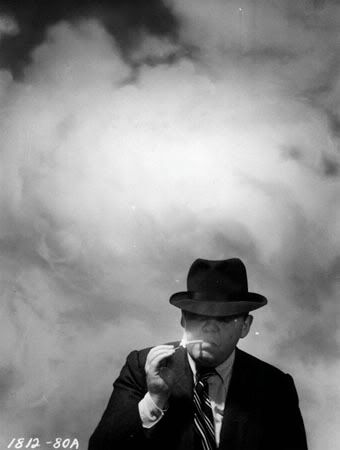
"Come on baby, light my fire"

"Anybody got a light?"

I love this picture! Charles is seductively looking at you while holding a cigarette, and, if you ask me, makes me feel like striking a match, or producing a lighter, or, as Bogey does in the cartoon "Bacall to Arms", a blow torch, if necessary!! (AND take this from a non-smoker!)

Anyway, what we can do today is to light the 109 candles in Charles' cake, and, as the cartoon Lauren Bacall says, just put our lips together and... blow these candles while we make a wish

Happy birthday, Charles Laughton, wherever you are!

Tuesday, June 17, 2008

Night of the Hunter Collector's edition DVD? Hmmm...

Well, this might be interesting news: recently, Classicflix announced the release by MGM, of a two-disk Collector's edition of "The Night of the Hunter" in September. Apparently, this edition has been temporarily postponed.

I do hope, as Clark does in his blog, that this delay means that MGM is taking the necessary time to deliver us the DVD this truly great film deserves... the DVD we are all dreaming about!. You name it: comments by experts, the film taken from the very best possible copy, with the fascinating out-takes of the shooting, with Walt's Schummann's soundtrack (Soundtrack solo version plus Laughton reading alonside version would be cool!), etc... Many of us have already seen the film on screen, TV, VHS tape or MGM's own previous release, yes, we have this already: Now... now we want something better!

The buzz's all over!
Of course, such news have arisen quite a number of comments in other blogs and forums! Check them and spread the word! Send your own links! Keep your fingers crossed! Send your good vibrations! Keep on sending your petitions!

:: Filmbo's Chick Magnet
:: John Bowman in his blog Fin de cinema
:: Ken Jennings in his blog Confessions of a Trivial Mind
:: The Criterion Forum
:: The Home Theater Forum
:: Film Score Montly's forum

Saturday, March 15, 2008

Una de maestros

English Abstract: After a brief exchange with fellow bloggers about education, I thought it could be a good idea to showcase, from the film "This Land is Mine", Professor Sorel's pep talk to Albert Lory (and to all teachers of all ages who feel overwhelmed by their circumstances)

"Esta tierra es mía" (This Land is Mine, RKO films, 1943) de Jean Renoir es mi película favorita. No sólo por la interpretación de Laughton, sino por su historia que trasciende el circunstancial mensaje de propaganda bélica, el simple alegato antinazi, para convertirse en una parábola sobre la libertad y lo que realmente supone ser un héroe. Y creo que una película que es capaz de convertir la lectura de los derechos humanos en un momento altamente emotivo es una película que hay que ver, al menos, una vez en la vida.

Muchos profesores se inician en la profesión con ganas de cambiar el mundo, aunque las circunstancias del mundo educativo acaben convirtiendo a muchos en enseñantes acomodados en su rol de funcionarios de la educación, perdiendo la motivación que les hizo escoger su profesión.

En "Esta tierra es mía" Albert Lory (Charles Laughton) es un profesor de primaria de un pueblecito. Vive con su madre que lo mima como a un niño -luego teme su propia independencia-, está enamorado de su colega Louise Martin (Maureen O'Hara) pero no se atreve a declararle su afecto y, de hecho, se avergüenza cuando sus alumnos hacen broma de sus sentientos por ella -luego teme a la expresión de sus propios sentimientos-.... Y esa es otra: es incapaz de controlar a sus alumnos. Para complicar más las cosas, la Alemania nazi invade su país, y a sus muchos temores se añaden el que ese enemigo fuertemente armado que oprime su pais con puño de hierro se de cuenta de que existe.

A Albert Lory, en resumen, el mundo le viene grande.

Un día, los aviones aliados bombardean objetivos la villa. Acurrucado y tembloroso en el refugio antiaéreo de la escuela, es evidente que Lory teme sobretodo a aquellos que le pueden liberar del yugo nazi.

Hay, sin embargo, alguien que sabe que bajo ese fardo tembloroso hay una persona de valía: el profesor Sorel (Philip Merivale) director de la escuela, mentor y figura paterna para Lory, que sabe encontrar las palabras adecuadas para motivar a su miedoso subalterno y ayudarle a superar sus temores... y a ser mejor maestro.

Nota: He transcrito el texto del doblaje de esta escena, no es 100% fiel al texto original, pero se le acerca bastante

- - - - - - - - - - - - - - - -

Profesor Sorel: ¡Adelante!

Albert Lory: ¿Me mandó llamar, profesor Sorel?

Profesor Sorel: Si, señor Lory

Albert Lory: Se lo que va a decirme, que hice el ridículo. Soy un estúpido, débil, no puedo evitarlo, soy... un cobarde

Profesor Sorel: No, no...


Albert Lory: ¡Si, soy un cobarde! No soporto la violencia, me aterroriza, no sé lo que me pasa con el ruido y las explosiones... Soy un cobarde y no puedo disimularlo ante los chicos, no se les escapa nada. Esta mañana se dieron cuenta, y usted también, y la señorita.. Martin

Profesor Sorel: Siéntese, señor Lory

Albert Lory: No, no, gracias... ¡Ahora ella ya sabe que soy un cobarde!

Profesor Sorel: ¿Quiere que le traslade a una zona donde no haya bombardeos?

Albert Lory: No, no... no, señor

Profesor Sorel: ¿Por la señorita Martin?

Albert Lory: Er... si

Profesor Sorel: ¿Sabe ella lo que usted siente?

Albert Lory (sacude su cabeza negativamente): Tut, tut


Profesor Sorel: Creí que era usted un solterón empedernido como yo. Hace años también yo me enamoré. Cuando ella murió, yo busqué consuelo en mi trabajo... El nuestro. Mi familia fue esta escuela: mis libros, mis maestros, usted, la señorita Martin... Muchos de mis alumnos ya son hombres. Ser maestro es algo maravilloso. Es el mejor trabajo que existe. Se sacrifica uno, pero consigue grandes cosas. Y ahora nuestro cometido es mucho más importante que antes, ahora hemos de sacrificarnos más que nunca: nuestro trabajo exige la máxima entrega.

Vino el alcalde esta mañana a hablarme del deber, pero yo prefiero utilizar la palabra trabajo. hay que quemar estos libros y los quemaremos. No podemos luchar físicamente, pero moralmente sí podemos hacerlo. Hemos leido esos libros que nos enseñaron la verdad, y no se podrá destruir la verdad sin destruirnos antes a nosotros. Imbuiremos en los niños la verdad si confían en nosotros y ven nuestro ejemplo. Tendremos que ser fuertes, Lory, eso complicará las cosas: A nosotros, nos creen débiles, no tenemos armas, nadie lucha, corremos a los refugios, y a nuestros héroes los llaman criminales y los fusilan. Ellos son soldados con armas, banderas y uniformes,exaltan la violencia, el egoismo, la vanidad, cuanto deslumbra a las mentes aun no formadas, y sus criminales son presentados como heroes... es una desventaja enorme para nosotros: el amor a la libertad no impresiona a los niños, ni tampoco el respeto a los seres humanos.


Pero hay algo que no podrán quitarnos jamás: y es nuestra dignidad. Será una lucha muy dura y muy difícil, pero si los niños nos admiran, nos seguiran.

Venceremos, Lory. O tal vez nos fusilarán. Pero cada uno de nosotros que maten, ganará una batalla, porque morirá un héroe, y el heroismo sí que atrae a los niños.


No le pido que muera, amigo mío...al menos ahora, pero piense lo que le he dicho, creo que le servirá de ayuda cuando vuelvan nuestros amigos con más bombas ¿podrá ocuparse de los niños y estar menos nervioso la próxima vez?

Albert Lory: Si señor, lo intentaré

Philip Sorel: ¡Bien!

- - - - - - - - - - - - - - - -

Por supuesto, hoy podemos sustituir "enemigo" por "concursantes de reality shows", "chulos y matones pandilleros", etc... y en general, todo orco que afrente a la dignidad humana. Que piensen los maestros que, al contrario que en el caso de Sorel o Lory, el defender unos ideales no implica jugarse el pellejo... tal vez sólo el cachondeíto de cenutrios y filisteos, pero eso es algo a lo que no hay que temer.


Por cierto, si no tuvierais ocasión de ver esta película en algún cine-club o cinemateca cercana, o en un pase televisivo, sabed que está disponible en un DVD editado por Manga Films, que ofrece tanto su versión doblada al castellano cómo la versión original subtitulada.

Friday, March 07, 2008

An interview with Terry Sanders

Visitors of this humble weblog will surely be interested in reading an interview with Terry Sanders at Indiewire

Sanders is an independent filmmaker, and known to "Night of the Hunter" fans as the second unit director. He and his brother Denis were close collaborators of Laughton in both that film and in the aborted project of "The Naked and the Dead"(Their script with Norman Mailer would be the one eventually used in the film as directed later by Raoul Walsh). Sanders, as you can gather from the interview is a born cinematographer and a very commited one to boot. One would like to read more details about his work with Laughton.

Personal note: visitors and friends might well be utterly shocked at how unfrequently I update this blog, specially as I have a loads of stuff queueing to be posted. I guess, I'm poor at organizing my time (I sure would require a Brian Donlevy type of inner-sergeant to discipline my schedule!), plus being almost non-stop working in the night shift of a very demanding work ever since last September... Still I promise that I'll be posting here for a long time coming. Slow as molasses, sure, but posting nevertheless. Stay tuned ;D

Off-topic: I understand that visitors of this site are enamoured with good acting, hence let me remenber you that, in a day like today, the great Anna Magnani would turn 100, so it woud be a good occasion to celebrate it watching any of her great performances . Tanti auguri, Annarella!

Sunday, December 30, 2007

Two items of the lost & found type

One of the great things of the internet era is much more easier to come accross things which otherwise should have been missed.

As an instance of that, I'm bringing to the visitors of this blog two examples of rare Laughtonware of which I just came aware through Youtube.

Filmed Galileo, by Ruth Berlau
Laughton as Galileo, William Phipps as Andrea and Mickey Knox as the Little Monk, in a photo from the Los Angeles staging

"In describing Laughton's Galileo Galilei the playwright is setting out not so much to try and give a little more permanence to one of those fleeting works of art that actors create, as to pay tribute to the pains a great actor is prepared to take over a fleeting work of this sort". So wrote Bertolt Brecht in "Building up a part: Laughton's Galileo".

It is indeed a pity that great stage work is usually only enjoyed by contemporaries, leaving little, or no trace for the future. Nowadays many stage performances may occasionally be captured in video, but older events are lost forever. Still, one can try to figure, even if in a platonic way, an approximative idea, from testimonials, reviews and pictures, how a performance might have been.

In the case of the 1947 stagings of Galileo, we have Brecht's word, and also the photographs which Ruth Berlau took during rehearsals.

Time ago, I was lucky to see a documentary titled "My name is Bertolt Brecht, Exile in U.S.A." (produced in 1989), in a local film festival: and I was thrilled to see that it contained silent filmed excerpts of Laughton's performance as Galileo. The directors (Norbert Bunge and ChristineFisher-Defoy) were present, so I asked Mr. Bunge about the footage, and he told me that there were filmed bits of the stage production in the Brecht archives in East Berlin. Very interesting to know. however, i was led to think that those were just only a few short filmed bits.

But recently, I came across a one-minute bit from a documentary about Ruth Berlau in Youtube ( Click here to watch it), in which, apart from it showing bits which I had not seen in the other documentary, it is mentioned that Ruth Berlau's filmed record is more extensive than I believed: she shot the entire play. Albeit it was done with a domestic camera, in Black and White, and from a static position (in fact, as an spectator might have seen it in the theatre), well, the mere idea of it being available to be seen is mind-boggling.

Click here to learn more about the documentary containing these images, "Red Ruth: That Deadly Longing"

Stopover in Bombay

Another surprise foud in Youtube is a video from a TV programme hosted and starred by Laughton titled "Stopover in Bombay". According to the notes accompanying the video, the show was never aired! It seems that it was a pilot of a series to be hosted by Laughton, who would also play parts in some of the series' episodes.

The date seems to be 1958, which is interesting, as it shows that, even though Laughton didn't do much films after "The Night of The Hunter", he was certainly busy, albeit in other mediums.

Click here to watch the video.

Tuesday, December 25, 2007

A propos Jane Wyman: The Blue Veil


Laughton, Jane Wyman, and director Curtis Bernhard resting between scenes

"The Blue Veil" (1951) is a rare film: one with a multi-stellar cast and two Oscar nominations which has almost dissapeared from sight. Of all the films from Laughton's filmography is one of the most difficult to locate. I must say that, while originally released in my country, I have yet to see a TV broadcast of it, let alone a video or DVD release. It was only through the kind help of an American Laughtonian (who sent me the tape which he had recorded, years ago, from a TV airing), that I was finally able to see it. Well, "see it" is here a figure of speech, as the image in the tape was somewhat faded, and the viewing was interrupted by commercial pauses here and there, so my comments on the film are bound to be somewhat incomplete: I can't, certainly, make a proper comment on the film's photography, such was the poor image quality of the tape.

Having watched it, I am of the opinion that the film is a good, watchable melodrama, well worth a DVD release. However, it seems that the same reason that has kept that film in the vaults, and unavailable for TV broadcasts or video releases so far, is a matter of rights' ownership. Honest, I don't think that it takes such an incredible amount of money to satisfy these copyright issues, so whoever the responsible, please, pay for thew rights so this film becomes available for view again.

The Blue Veil was based on a French wartime film "Le Voile Bleu" (1942). It was released in the United states after the war (1947) and it is likely that its American release impressed RKO's studio heads enough to consider an American adaptation. It certainly looked like a good vehicle for Jane Wyman to star in: The young actres had proved he could play substantial lead roles and character parts, and her ascending star through films like The Yearling, Johnny Belinda (for which she won an Oscar) , Stage Fright, made of her an ideal actress for a melodrama such as "The Blue Veil".


Spanish herald advertising the film

The film was indeed meant as a quality product, apart from a spectacular cast including
Jane Wyman, Charles Laughton, Joan Blondell (who would earn an Oscar nomination for her role in the picture), Agnes Moorehead, Cyril Cusack, Everett Sloane and Natalie Wood.Norman Corwin, the famed radio writer, was responsible for the adaptation of François Campaux's original story. You may remember Corwin as the author of the screenplay of "Lust for Life", but I'd like to point here that Laughton had worked in a number of remarkable radio programmes written by him: It is not a widely-known fact from Charles' career, and unfairly so, as these programmes are indeed worth listening and should be recovered... But then this is another story, to which I'll come back in another post sometime in the future.

Maybe the lower-profile element of the film is the director, whose name won't ring many bells, even to dedicated filmophiles, which may disregard him a priori as a journeyman. Curtis Bernhard had been working mainly in Germany, a country which he had to leave prior to the Second World War, as so many did, due to the fact that he was Jewish. He was therefore part of the exiled European contingent which enriched the former Hollywood with their talent and/or craftmanship. His directing in "The Blue Veil", while not spectacular, is competent enough.

The story
(you may skip the next few paragraphs if you don't want to be spoiled about the plot)

American first release poster

This is the story of Louise Mason, a woman who loses her husband in First World War, and then her child. Looking for a job, but not having any special training or skills, she is eventually offered the chance to work taking care of children.

Her first customer, a recently widowed corset-maker (Charles Laughton), is so satisfied about how she keeps his child, and so drawn to her good character, that he proposes her marriage: she kindly declines, as she rightly guesses that it's the man's uncapability to bear a lonely life, rather than genuine love, what motivates his otherwise well-meaning proposal. However, the corsetmaker's secretary has no such qualms and marries him, and with the child having a new mother, Louise looses the job.

Her next employers are a wealthy couple (Agnes Moorehead and Don Taylor). Louise takes care of the younger son, while his older brother is tutored by an idealistic young teacher who resents his steady, but far from exciting job, and yearns for far horizons. Louise and the teacher get friendly, and, when he takes an offer to work in a foreign land, he asks Louise to marry him, and she accepts. Her employer wishes them the best of luck, even though she tells them that she feels that the whole thing is a bit rushed. Louise has no doubts, but her suitor suddenly becomes hesitant. Feeling her fiancé is too doubtful about such their future relationship, Louise refuses to marry such a vacillant partner and returns to her work.

We next see Louise taking care of a teenage girl (Natalie Wood), the daughter of a singer (Joan Blondell). The singer is very devoted to her career, to the point that she neglects her daughter, who increasingly turns to Louise as a mother figure. When te singer doesn't attend the girl's confirmation due to an important audition, the girl introduces Louise to her friends as her mother. Considering that the whole thing has gone too far, Louise quits, not without telling the singer her reasons, which realizes that she should be more of a mother than she has been, and ready to turn down offers for future shows which might come between she and her daughter.

Later, Louise is employed by a young couple. The husband is British, and when a new war breaks out in Europe, he leaves the Sates to join the army. When the husband is wounded, his American wife leaves as well to take care of him, enthrusting her child to Louise. The husband dies and her widow marries someone else again, forgetting about her son. Years pass and Louise has become, to all efects, the child's mother. Sudenly, she gets a notice that his biological mother and her new husband have returned to claim the child, but Louise refuses to give them back the boy, who is like a son to her, to a mother that hasn't cared for him in years. The District Attorney (Everett Sloane), gives the kid back to her biological mother, even though he considers Louise to be the real mother. But he must stick to what the law says.

Louise is now an aged woman, and she is considered too old to nurse children. Having no other working experience, she ends as a cleaning woman in a school, where at least she's in contact with children, but otherwise leads a lonely life with no-one to take care of her in her old age... Will all the unreserved love she gave to so many children go unrewarded? Maybe, maybe not... Hey! I'm not spoiling the end :p

Comments
This is the kind of film which is usually described as "tearjerker", yet its efficacy in the Kleenex department doesn't mean it is an overwrought melodrama... In fact it is quite restrained. Examples of it might be the almost-silent scene when Louise realizes that something is going wrong with her child, or the scene where she quits her job at Joan Blondell's home, where, in a crucial moment, we only see her back when we could see her tear-stained face.

To many spectators of today, used to more cynical approaches, the character of Louise might strike them as outlandish in her unselfishness... Yes, this woman who becomes the surrogate mother to all children under her care, only to be left heartbroken when she has to leave the job, is nearly a saint. But then we've all known about people who is able to sacrifice themselves for others. Also, Louise is counterpointed by the misanthropic toy-store owner played by Cyril Cusack. Cusack seems to have the store, not because he likes children (he doesn't: he's inclined to scare them out of the place), but because he's an overgrown child himself: So maybe it's no wonder he becomes friendly with nanny Louise.

On the other hand, we also see Louise considering to have a life of her own: first, when she accepts the teacher's marriage offer, even though she's disappointed by the selfish love of grown men, and returns to the unconditional love that children give her. Second, when she raises her ward as if she were her actual mother, and resists the idea of giving him away.

As a Jane Wyman vehicle, she certainly makes the best of her performance, suggesting well the loving, sacrificial nature of the nanny-nurse in a quiet way. This gives more strength to the scene where she claims to the District Atorney the custody of the boy she has mothered for years: the frustration of her not being a biological mother is patent there. She also ages convincingly, even though the kindly, older Louise isn't quite like Angela Channing, the shrewish matriarch that an older Jane Wyman played many years later in the TV series "Falcon Crest"

Personally, I have one complaint. I know the film was done in other times, but I resent that the Joan Blondell character is presented as selfish for wanting to maintain her career as a singer, instead of being a full-time mother: she has to earn her keep, doesn't she? In contrast with this, we don't see, for instance, a criticism of the Charles Laughton character for directing his corset factory and leaving his son in the hands of a nurse (however competent)... Ah, forgive me, I'm just sensible about these issues..

On Charles' performance

Charles as Fred K. Begley

Oh, but of course we should be talking about Charles a bit... shouldn't we? ;D

"The Blue Veil" is one of those films which figures in his filmography, but is rarely reviewed or mentioned in books about him. The logical reason is that it is a hard-to-get item, or a "lost" one. This is not an unique case among his films, though maybe "On Our Merry Way/A Miracle Can Happen" (where Laughton's participation in the film was considered lost) would be more of a case in point. Laughton only appears in the first part of the film as Jane Wyman's first employer. Interestingly, Laughton has quite a number of episodic films in his career, in which he gave performances short in footage but grand in quality ("If I Had a Milion" could be the topping example).

Laughton's Fred K. Begley is a man devoted to his corset factory, he finds it hard to live alone, so Louise not only solves the child-care issues, but also becomes a confidante he can trust: they become a family of sorts. However, it is not actually a family, and Mr. Begley ends proposing to the nanny: Laughton uses a polite, but very matter-of-factly way to do it, quite becoming to a businessman. In fact, more than a marriage, he seems to be proposing a commercial partnership. And he accepts Wyman's refusal like a sport, even though, as soon as he leaves her room, he drops his façade and we see him walk sadly down the corridor. In this moment of bleak defeat, he gets a call from his secretary, and Laughton brightens so much during the conversation that it s obvious that it is not bussiness that he's talking about: it is the realization that he's not alone as he thought he was..

Back from the honeymoon, the new Mrs. Begley is ready toi take care of the child, and she believes that the Nanny is no longer needed. Laughton's sadness at the thought of loosing Louise reveals that he doesn't agree with the idea, revealing that the dominant boss at work is a bit of a henpecked guy at home.

In all, he gives a touching, competent character study.

Thursday, November 15, 2007

"I don't want to set the world on fire..."


I just love this photo: it is one of the favourites in my collection of Laughton stills. It is to me a metaphore of how Laughton's talent set the world on fire, particularly in his décade prodigieuse of the thirties, where he awed the world with a string of great performances.

He's got a charming air canaille in the picture... Not unbecoming, as Laughton was enamored with France, a country whose language he spoke fluently. Being a francophile is not an usual choice for an Englishman, but then Laughton was a citizen of the world avant la lettre.

There's a date in the copy: 1939. Whereas this date refers to the year the photo was made or just the one in which it was printed, it is significative, for the clouds in the background seem a symbol of the bonfire that had burned Spain and was about to spread to Europe and the rest of the world. Laughton's own prospects were burnt-out as well: the films produced by "Mayflower Pictures", the film company he had set up with the legendary German producer Erich Pommer, hadn't met with the required success on their original releases. And Laughton, with the savings made by years of hard work gone, and broke, was again an actor badly in need for a job, and had to accept a contract with RKO pictures to clear his debts and that of his British film company .

As it happens, this would result in one of his greatest performances, and a fitting way to top his extraordinary work of the thirties: Quasimodo in "The Hunchback of Notre-dame". He and Pommer had thoughts of re-starting their company, which were definitely shattered by the start of the hostilities in Europe and its effects on foreign film markets.

But I digress... The subjet of this post wasn't actually that. In fact, I wanted to reflect about how different are our times from 1930. Had Laughton lived today, no doubt he'd be able to live his personal life more freely. But if our times are more tolerant on some areas, have grown more narrow minded in other regards... If Charles Laughton, actor, lived today... would be allowed to set the world on fire? Probably he wouldn't even be allowed to light a match!

Consider me a pessimist, but recent talk about Leonardo DiCaprio playing emperor Claudius in a prospective film version of Robert Graves' novel "I Claudius", or Jonathan Rhys Meyers playing Henry VIII in the TV series "The Tudors" doesn't strike me as good news.

Don't misunderstand me, I'm not meaning that these gentlemen can't do the job, but the thought of handsome, hunky guys playing historical characters that may have not been, precisely, the kind of people you'd see in a Hugo Boss advert, doesn't make me too happy.

And even less so, after reading a recent interview which I recently read in La Vanguardia's section "La Contra". On the October 22nd of the current year, Lluis Amiguet interviewed plastic surgeon Thomas Biggs. The doctor mentioned the case of a well-known character actor (1) who had to be operated urgently : seemingly, the actor was to play a romantic scene, and it turned out that he had a bit of double chin, which the director considered intolerable for the camera to capture...

In Laughton's times, an actor with talent could become a world-famous star even if he didn't look debonair. Nowadays, eugenics seem to rule, and soon non-hunky actors won't be even allowed to play bit character parts, however talented they might be.

Notes:
1) The victim of intolerance against normal looks, according to Dr. Biggs, was Ben Gazzara.

Sunday, November 11, 2007

About Norman Mailer's "The Naked and the Dead"


Norman Mailer just passed away. I don't know how many of you know that, had "The Night of the Hunter" fared decently in the box office, Charles would have directed a second film, based on Mailer's "The Naked and the Dead".

In fact, Laughton was already working in the film's script with Mailer. As he had done with Davis Grubb, he considered that the writer's own contribution was vital to the final film (a certain sign of respect for literature). By the time his first directorial effort was on its way for release, Laughton was already working in his next film with Stanley Cortez and the Sanders brothers, who had collaborated with him in the making of "The Night of the Hunter". As a matter of fact, Cortez went to Hawaii to scout locations for that film.

This is covered in some extension in Preston Neal Jones' very commendable book . There's one priceless anecdote about Laughton and Mailer discussing the script which I don't want to reveal (read the book, punyeta!). It is also recorded there that names like James Stewart, Burt Lancaster, Richard Widmark and Robert Montgomery were being considered at this early stage to act in the film. Both Cortez and Terry Sanders recall very interesting visual narrative ideas that were being conceived to be in the film. As in "The Night of the Hunter", it seems that we would have had a film that was ahead of its time, with daring new cinematic devices that would still be influential today. Sanders also mentioned that the final script was "quite magnificent".


Charles Laughton in 1917, while undergoing early army training

I always wondered how Laughton would have approached the subject of war. Having himself experienced war first-hand as a foot soldier during First World War, and having never talked extensively about his time in the army, the film could have been revealing about his own insights about men and war. Unfortunately, the critical and box-office indifference to "The Night of the Hunter" meant that the prospects of a second film directed by Laughton got difficult. Laughton was himself disheartened an the failure of his first-born, and felt discouraged to keep on working in his second film. Alas.

The film was eventually produced by Paul Gregory, and directed by Hollywood veteran Raoul Walsh. Cortez later would say that, upon seeing the finished film, it was, as compared to what Laughton had envisaged "It was like day and night". Gregory himself, who split his association with Laughton after "The Night of the Hunter", admitted himself that Laughton would have made a better film, as he had the poetry that Walsh's approach lacked.

One wonders if the script is anywhere to be read. It wouldn't be like watching the actual film that Laughton had in mind, but one would at least get a smattering of what it could have been.

Thursday, October 04, 2007

An interview with Paul Gregory

Those of you with particular interest in "The Night of the Hunter", might like to read this online interview with the film producer Paul Gregory.

It seems that Gregory and Mitchum didn't, hum, precisely, get along together very well XD... I know this may be one of the better known items of Hunteriana, but it is interesting to read it from Gregory's perspective

Also, I admit I had never read about Gregory's youth in London....Attending school with embassy children? Hmm...


Note:
I found this interview linked in the blog "Dispatches from Zembla" , In a post where he discusses Laughton's film and Simon Callow's BFI booklet about it.

Saturday, September 08, 2007

Wrong sailor in the boat

One of the anecdotes about the shooting of "Mutiny on the Bounty" (The 1936 version, of course!) is that the scenes about Lieutenant Bligh's epic travel in the Bounty's launch to Timor were shot twice, which made the shooting of those scenes a little odissey by itself.

The reason was that one of the actors that were supposed to be among the mutineers, was mistakenly in the launch among with those remaining loyal to Bligh. Charles Higham's book on Laughton put the blame on young actor Eddie Quillan, who was playing the young mutineer Thomas Ellison, and should be in the "Bounty", not the boat.

But then I got these two old stills:


In this one we have Laughton with Franchot Tone, playing Midshipman Roger Byam, who was the fictional equivalent of Peter Heywood, one of those who remained loyal to Bligh in the Mutiny but remained in the Bounty for lack of room in the launch, so well... he shouldn't be there.


In the second one, we see Donald Crisp (second sailor right of Laughton), who played one of the most conspicuous mutineers, Thomas Burkitt, and wasn't supposed to be in the launch, either.

So maybe the blame shouldn't go just to poor Eddie Quillan.

One thing I can say for certain is that both Tone and Crisp are made up as they looked as prisoners in HMS Pandora, the ship the Royal Navy sent to capture the mutineers. I wonder if the make up experts responsible for the scruffy looks of the members of both the Bounty launch and the prisoners at Pandora's box were around for a limited time, and this prompted a bit of confusion at both the filming and the shooting of stills.

Curiously, the actor I don't recall at all in the launch was Herbert Mundin. who played Bligh servant in the Bounty, he is neither seen among the mutineers nor among Bligh's loyals after the mutiny... Maybe because he was there for comic relief, and the launch trip was very dramatic stuff indeed. Still, what a goof.

Incidentally, being based in a novel, not the actual facts, there's always been criticisms about its historical accuracy. One of the greatest ones, in that sense, is the presence of Bligh aboard the Pandora, there to find Christian and his mutineers and make them pay for their rebellion. Actually, Bligh was on a new breadfruit expedition, and the Pandora was commanded by Captain Edwards, who was far nastier than Bligh. I haste to say that, although not accurate, Bligh in the Pandora made for one of the most dramatic moments of the film.

The Pandora also shipwrecked, and Captain Edwards had to bring to safety both his crew and his prisoners in boats, in a trip not unlike Bligh's journey to Timor. If it weren't because the actors in the still are mostly those whom se see in the film as Bligh's loyals, I'd drop the crazy theory that the trip of the Pandora's boats wers filmed, too, but cut in the final editing, ;D

Whatever, whoever was the actor responsible of being the sailor in the wrong boat, the rest of cast and crew were obviously oblivious of the fact, too. The making of "Mutiny on the Bounty" took about two years, but Charles' work in it was during a few weeks, due to other film commitments, so the scenes with Bligh were filmed all together over a short period of time: this might be one of the reasons for that continuity mistake, and also gives the impression that having to film those scenes again must be an extra source of stress for those involved, specially Laughton, who had to return to England to work for Alexander Korda.

The irony is, that when he came back, Korda kept him idle for months while throwing prijects and ideas to Laughton: one gets the impression that Korda's aim was to keep Laughton from working with other people, as this strange period of inactivity in Britain contrasts sharply with Charles' busy schedule when in Hollywood... But that's another story.

Friday, November 10, 2006

All singing! All dancing! All busking!


Charlie Staggers (Laughton) entertaining a queue

Pat Cronenberg recently brought to my attention this recent bit of news about the New York Première of "Busker Alley", a musical inspired by "St. Martin's Lane", a 1938 Mayflower picture starring Charles Laughton. A one-night only benefit performance featuring Glenn Close will be staged on November 13th.

I am a bit surprised, as "St. Martin's Lane" (released in the USA as "The Sidewalks of London") wasn't, shall we say, an spectacularly successful film. Though, as Edward Copeland pointed recently, nearly everyone has heard about the musical "Chicago" while most people is ignorant about the existence of the film "Roxie Hart".


behind the camera of "St. Martin's Lane", from left to right : photographer Jules Kruger, director Tim Whelan, producers Erich Pommer and Charles Laughton

While it is true that the films produced by Mayflower Pictures (the company set in 1937 by German Producer Erich Pommer and Laughton) failed to meet the high hopes that the union of such illustrious film personalities seemed to herald, they have their points of interest which, in my humble opinion, make the film well worth watching.

In the case of "St. Martin's Lane" , there's a touching performance by Laughton as a doomed-to-fail yet ultimately hopeful busker, a pre-"Gone With the Wind" Vivien Leigh as a volatile cockney girl, a very young Rex Harrison as a posh song composer, a filmed record of Harmonica Soloist Larry Adler's virtuosism , as well as a documentary record of the pre-WW2 London: many scenes were shot actually in West End streets and real street entertainers appear performing themselves.


Vivien Leigh (Libby) and Laughton

One of the usual criticisms of the film is that accomplished as it is the portrait of low-life London, the high-life and glamour musical scenes fall flat. While true, I feel that the key to this is that the musical scenes were, as those of the back alleys of the West End, seen through a realistic looking glass: used, as most of us are, to lavish film musicals (with numbers which can only exist as such on the screen), we may be deceived at watching how an actual musical show may have looked like in the 30s.

Incidentally, the premiére of "Busker Alley" almost coincides in time with a Zone 2 DVD release of the film (there's already a Zone 1 DVD published by Kino)

P.S.:
Don't think the "Night of the Hunter" campaign is over, further installments are queuing to be posted ASAP. Keep spreading the word, ye faithful keepers of the flame.

Wednesday, October 18, 2006

Linking, linking....


Illustration: "The Night of the Hunter" © Rod Filbrandt

... and now for a few interesting links about "the Night of the Hunter"

The great illustration you see here is the work of Rod Filbrandt, you can see it here as originally posted in his graphic blog chowderheadbazoo

Some more links:
:: " Charles Laughton: Night of the Hunter " A review by Derek Malcolm in The Guardian
:: "Why I love Night Of The Hunter" by Margaret Atwood, originally published in The Guardian
:: Text and Texture: A comparative analysis of The Night of the Hunter, Cape Fear (1962) and Cape Fear (1991) by Harvey O'Brien
:: "The Night of the Hunter" reviewed by Moviediva
:: A great page about "Night of the Hunter" photographer Stanley Cortez
:: "The Night of the Hunter", a film review by Pete Croatto

Ackowledgements:
I must thank William Turgeon for bringing to my attention many of the online articles and reviews here, also to Rod Filbrandt for kindly allowing to link to his illustration.