•  •  •  •  •  •  •  •  •  •  •  •  •  •  •  •  •  •  •  •  •  •  •  •  •  •  •  •  •  •  •  •  •  •  •  •  •  •  •  •  •  •  •  •  
We're campaigning for a Special DVD edition of "The Night of the Hunter": Join the cause!
•  •  •  •  •  •  •  •  •  •  •  •  •  •  •  •  •  •  •  •  •  •  •  •  •  •  •  •  •  •  •  •  •  •  •  •  •  •  •  •  •  •  •  •  
Showing posts with label Night of the Hunter. Show all posts

Tuesday, August 17, 2010

A Miracle Can Happen


Today I was feeling like Félicie, the heroine of Eric Rohmer's Conte D'Hiver , because, you know, I found out that it's worth waiting for miracles to happen, even if the chances are seemingly infinitesimal.

What happened, then? Well, you may remember that a couple of years ago there was talk about a new DVD release of The Night of The Hunter. The project seemed shelved shortly after its announcement, and I crossed my fingers in case that cancellation was for the better.

And then today, Professional Tourist most kindly e-mailed me the news. Well, fasten your seatbelts!:

Night of the Hunter will be released in november in a two-disk DVD and Blu-Ray edition. By Criterion. With loads of extras.

I will confess that a NOTH edition by Criterion was the ultimate dream of many film-lovers. Personally, the actual release comes very near to my wildest cinephile dreams :


:: New, restored high-definition digital transfer (with uncompressed monaural soundtrack on the Blu-ray edition)
:: Audio commentary featuring assistant director Terry Sanders, film critic F. X. Feeney, archivist Robert Gitt, and author Preston Neal Jones
:: Charles Laughton Directs “The Night of the Hunter,” a two-and-a-half-hour archival treasure trove of outtakes from the film
:: New documentary featuring interviews with producer Paul Gregory, Sanders, Jones, and author Jeffrey Couchman
:: New video interview with Simon Callow, author of Charles Laughton: A Difficult Actor
:: Clip from the The Ed Sullivan Show, in which cast members perform live a scene that was deleted from the film
F:: ifteen-minute episode of the BBC show Moving Pictures about the film
:: Archival interview with cinematographer Stanley Cortez
:: Gallery of sketches by author Davis Grubb
:: New video conversation between Gitt and film critic Leonard Maltin about Charles Laughton Directs “The Night of the Hunter”
:: Original theatrical trailer
:: PLUS: A booklet featuring essays by critics Terrence Rafferty and Michael Sragow


You see, the extras are substantial in amount and quality: One the most welcome features are Robert Gitt's documentary Charles Laughton Directs The Night of the Hunter, containing precious outtakes of the film, and the comments, interviews and contributions by first-rate Laughtonians and people who participated in the making of the film.

One still would have wished a few more items: I feel that Simon Callow's 1987 documentary about Charles Laughton would have been a fine addition to the luxuriant list of extras, and hopes that the interview can make up for it. I'd also liked that there was an extra disk containing the original soundtrack... Still, this upcoming release sounds like near perfection, and will certainly be welcomed by most.

I'd like to thank anyone who ever spread the love for this film, and particularly, those who joined this blog's campaign, which I hope helped at least to send the right vibes for the thing to happen, also to a few choice entities who have obviously been very thankful for their wax candles. And thanks indeed to the guys of Criterion, for taking the challenge and making a dream come true!

Monday, April 05, 2010

The last of Ben Harper


"I'm going now, children... Goodbye"

While most obituaries about the recently deceased Peter Graves remember his work in the TV series "mission impossible", many of you may also remember him as Ben Harper, the good man whose only day of dishonesty takes him to the gallows, a short but relevant role in The Night of the Hunter...
I was working with John Ford in a picture. One day I started to say: "About this scene. This part I'm playing. I think that–" Ford snapped me shut. "Don't think in my picture, " he growled. Moving from Ford to Charles was like moving from hell to heaven

So stated Graves when asked about his memories of The Night of the Hunter. Laughton is sometimes pointed as a "difficult" actor by some directors, but Peter Graves' comment makes evident that even actors without a feisty reputation on the sets resented being treated by directors as if they were objects. It should be no surprise that, when Laughton was behind the camera, wouldn't forget what it felt like to be in front, and in consequence, be considerate towards them, to the point that he wouldn't interrupt takes with a "Cut!", and keep the camera rolling, in order to preserve his actors' concentration (this curious proceeding, by the way, left a remarkable lengtht of precious celluloid).


Laughton directs Preacher trying to convince Ben Harper about making a substantial donation to his holy cause

I'll give you again a link to a recent interview with Peter Graves .

Plus a few homages in the blogosphere: Plumas de Caballo , Bright Lights after dark , Screensavers , Edward Copeland on Film.

...And in the online press: The Guardian , The New Yorker , The Times , The New York Times , Los Angeles Times , El Pais.

Sunday, October 18, 2009

Two number ones (and a number of quick ones)

As mentioned previously in another post, I'm not of the opinion that a position in a list is what makes a film great. Still, since there's people influenced by "umpteen best films" lists, I've got to say that they have its use... For one, they may attract the interest of filmgoers towards "oldies" and, well, help overcome their reluctance to watch films in Black & White, for instance.


In the particular case of Charles Laughton's "The Night of the Hunter", this may also give a measure of the growing reputation of the film which all but seemed doomed to oblivion when it was first released. I'm well aware that high-ranking places also usually draw the attention of Phillistines and Iconoplastas who'll raise hell just for hell-raising's sake (... or because the poor things have nothing better to do, tsk!)

"Ah! Je souris de me voir si haut dans cette liste..."

Anyway, here it goes: the British magazine The Spectator put "The Night of the Hunter" in the number one of their Best Films list. This was brought to my attention by a couple of fellow Laughtonians, who sent me this link by Roger Ebert commenting on the issue (and Ebert is a great appreciator of Laughton's only full opus behind the camera)... Not only this, for Time Out, the British entertainment weekly guide, also lists the film as the number one among first films of a director's career, which is considerable kudos to give, considering that they've listed as remarkable film debuts as "Citizen Kane", "Les Quatre Cents Coups" , "The Great McGinty", "Targets" or "L'Age d'Or" below Laughton's film.

I must say I get an extra kick of this recognition coming from the British press. Over the years, I've got the overall impression that Laughton, while certainly apreciated by the British public, wasn't as recognized by the British powers-that-be. But never mind... Charles may have not got titles nor royal honours, but sure he still gets lots of love... Worldwide!

On the light of this, it might be interesting to watch this little snippet from an American TV program (dated around february 1960):


"Guess who's playing Falstaff"

The host's final comment to Charles about the American public's affection is worth noting: Laughton certainly seems to feel at home, willing to charm and full of energy and projects: it's sad to realize he had barely a couple of years left to live (By the way: It's funny to listen to the blindfolded pannelists assume that any British-born actor has a title). It is intriguing to learn that there was a broadcast of the Stratford 1959 production of A Midsummer Night's Dream (with Charles playing Bottom) which was shown in America but not in the United Kingdom (hum... Why?!)

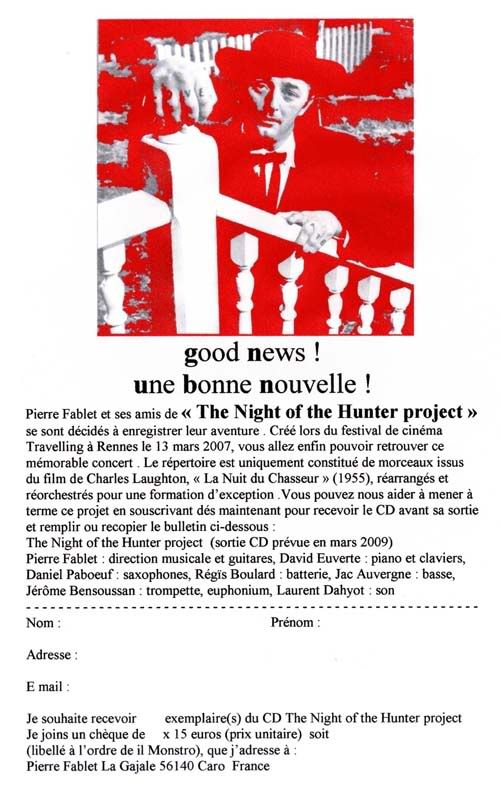
Pierre's Fablet "Night of the Hunter Project" has finally seen the light in a handsome CD distributed by Harmonia Mundi. This is just so you know, for, as you can imagine, the recording is truly worth of a post of his own, which I hope to do as soon as circs allow.

Those of you fortunate Laughtonians living in the vicinity of Chicago, Illinois, will be glad to learn that there's is a Laughton season going on there until December 3rd: here at evanevanevan.com you can read a nifty essay on Charles' career, as well as details about the screenings.

In the film releases front, I'm happy to announce that "The Bribe" is finally going to be on DVD, in the Warner Bros "Archive Collection", which, as some of you may know, is no regular DVD release, but one that works on customer's orders (you order it, and they make a digital copy for you). The bad side is... it's a Zone 1-only release which cannot be purchased by anyone living outside that geographical zone... In short, some genius at the top of the company think that, outside the north of America, nobody is interested in film classics.

(Note: if any kind American Laughtonian is willing to make an order for me, please send a message to this blog so we can make an arrangement, ahem)

Wednesday, July 29, 2009

Spring blades

A knife cutting through a pocket. Fans of "The Night of the Hunter" are familiar with the image, arent they?


... Wait, I don't recall this frame from the film... What's wrong?

Quite simply, this hand isn't Robert Mitchum's but Lon Chaney's, and this frame doesn't belong to Charles Laughton's "The Night of the Hunter" (1955), but to Wallace Worsley's "The Penalty" (1920), which David Cairns commented upon on a post at Shadowplay. It was Mr. Cairns who mentioned the scene in the comments, and I was duly intrigued.

When he posted me the screen capture seen above, I was truly awed, but let's recap and go back to "The Night of the Hunter"


Well, we have Preacher Powell attending a Burlesque show... Not that he likes it, in fact, he seems to find it rather disgusting.


So he clutches his left "Hate" fist, hides it inside the pocket and... "Snikt!"

Mr. Cairns believes that the scene in "The Penalty" might have inspired this one from "The Night of the Hunter", and it doesn't seem unlikely... Didn't the gardener tell Brecht "I steal from all places"?

Such a scene, by the way, is not in Davis Grubb's original novel, the most similar situation there being a scene prior to preacher's detention, in which he is ready to loosen the blade of his knife as a prostitute proposes to him in a brothel... One imagines that the whorehouse was transformed in the film into the -no less sleazy- Burlesque show to avoid censorship, but it is striking that the censor didn't object to the gleaming, phallic knife cutting through the clothes. The scene follows faithfully the definitive version of the script, and, from pictorial evidence, Laughton took great care in directing Mitchum's hands there.


Good direction is in the tiny details

Back to "The Penalty" , the knife cutting through Chaney's pocket is suggestively menacing, though it lacks the connection between Eros and Thanatos so strongly stated in Laughton's film. At any rate, this scenes reminds us of how "The Night of the Hunter" recovered the powerful storyteluing of silent movies, a power which was gone with the sound.

We could conclude that there might be a Worsley & Chaney connection with Laughton beyond "Notre-Dame de Paris"

Wednesday, July 01, 2009

Here's looking at you


Charles Laughton is often referred to as an insecure fellow. I'd like that those thinking this way would take this image into consideration. He stares at you with a confident stance, it could be said, in fact, that he's challenging the viewer.

The image is from 1932, and quite likely (from the haircut) near the time he was working in "Island of Lost Souls". At this moment, he's the newbie who's holding Hollywood in awe. He doesn't hesitate to hold for his vision of the character he's playing, even if he has to hold it against a Hollywood big fish like Cecil B. de Mille, and he's only been in town for a few months.

He had arrived to California with an agreement with Paramount to work in a couple of films a year, so film work didn't keep him from working at the British stage. When he returned to London some months afterwards, he had shot six pictures. For Paramount, but also for Universal and Metro-Goldwin-Mayer. By the time he was about to work in his fourth film, his wife Elsa Lanchester (often referred as his bolder better half) had returned to London in a seizure of homesickness. Of course, she was also understatably frustrated about Hollywood's myopia, who back then perceived her just as the new employée's wife. Elsa had a protective attitude towards Charles, though it is evident that he did reasonably well when he was left alone in the Tinseltown wilderness for the months he was without her. He returned to London able to say he had made it.

You should know that, a mere seven years ago, one of 1932 Hollywood sensations had -finally- convinced with his family of hoteliers to allow him to give a try at becoming a professional actor. They, of course, believed that Charles would return from his foolish adventure soon enough, tail between legs, to assume his destiny as an hotel manager. But Charles would never again be an hotelier, and his mother and brothers would gape in disbelief when he not only eventually became a professional actor, but got to play leads in the West End.

What was he thinking when the photographer shot this image? Maybe "And tou thought I wouldn't make it, eh"?

I'd like to think he was thinking "Here's looking at you!"

Insecure you said?

...Right, this was again the Charlie Birthday Special, and I'd like to finish it with a few goodies for you all.

I generally bookmark CL-related links for when I have to deal with an specific film or play in the -near or far- future, but I have a couple of Laughton celebrations in the blogosphere which I'd like to bring to your attention: one is by Matthew Coniam at Movietone News , a celebration of the actor focusing in his pre-code films, and the other is by Joseph "Jon" Lanthier at Bright Lights After Dark, asking the oil painters of the world to unite. Both post will be treat to any Laughtonian.

Talking about treats, I'd like to mention Criterion's recent DVD release of David Lean's "Hobson's Choice" (Zone 1), coming, like every DVD release should, with appetizing extras. If that weren't enough, Criterion's website provides a number of very readable articles on Laughton and the film: Graham Fuller's "Charles Laughton: Size matters" , Armond's White"Hobson's Choice: Custom-Made" , and links to press notes.

Also, Criterion's kid sister company, Eclipse, has released a special boxset, "Alexander Korda's Private Lives" which includes "The Private Life of Henry VIII" and "Rembrandt". Again, a Zone 1 release, though, as usual in Eclipse's releases, without extras. Again, we have at their website an interesting article about this release as Michael Koreski's. There are nice external reviews, too, such as Jon Lanthier's here and here ("Korda cudgel"... XD), Dave Kehr's at the New York Times (these and some other comments on the subject can be found linked by David Hudson at IFC.com

And that's not all! In the last months, a couple of interesting books new books about "The Night of The Hunter", one is "La Nuit du chasseur - Une esthétique cinématographique" by Damien Ziegler, and the other "The Night of the Hunter: A Biography of a Film" by Jeffrey Couchman. I'll post about them in the near future, promise.

Now you may blow the candles.

Sunday, December 07, 2008

Hunter Jazz, and a list of one hundred films

Just a few posts before, I talked about a project by Mr. Pierre Fablet and a ensemble of jazz musicians: a jazz concert inspired by "The Night of The Hunter", and Walter Schumman's score for it.

The good news is that Mr. Fablet's project to record the concert is going ahead. To that end, he has opened a subscription: anyone who'd like to contribute to make the CD release possible can participate (For those of you interested click here for a subscription leafleet).

I hope the CD becomes a reality soon and I can make a post about it ;D

Second!
At the time of its release, one of the few appreciative reviews that "The Night Of The Hunter" received was one by Francois Truffaut. Truffaut sadly realized that Laughton's original parable was bound to be too conventional for Hollywood's staple: while praising Laughton's film-making as having the courage "to knock over a few red lights and some traffic cops in his unusual film. It makes us fall in love again with an experimental cinema that truly experiments and a cinema of discovery that, in fact, discovers" he also predicted that "screenplays such as this are not the way to launch your career as a Hollywood director. The film runs counter to the rules of commercialism: it will probably be Laughton's single experience as a director".

Recently, a group of 78 critics were asked by Cahiers du Cinema (the renowned French magazine to which Truffaut used to contribute) to vote for their favourite films: the result lists one hundred films, of which Laughton's "The Night Of The Hunter" ranks second, tied there with his good friend Jean Renoir's "La régle du jeu" (I just love that tie, particularly since Charles and Jean's joint 1943 effort is what made a Laughtonienne out of me).

I've read a number of online comments about that list which question the selection, and of course a list of just one hundred film, however remarkable, is bound to leave a good number of films outside, in fact a list of a thousand films would also undoubtedly leave out many films of worth. Maybe I'd add more films to a personal list, films by Mikio Naruse, Jose Luis Berlanga, Isao Takahata, Alexander Mckendrick, Norman MacLaren, Marco Ferreri, Albert Lewin, Hayao Miyazaki, Powell & Pressburger, Pedro Almodovar, Preston Sturges, Bertrand Tavernier or Mitchell Leisen, among many others, but then there is such a lot of films I still have to see that... well, I'd probably leaving out a lot of excellent films as well!

Anyway, I don't think that the list was meant to be an "absolute" one, those critics voted their their favourites, and wether you agree or not with their choices, I don't see bad films there. And... well, yours truly is awfully pleased that "The Night of the Hunter" made it number two ;p

Notes
(1) Truffaut's review for "The Night Of The Hunter" is published in an enjoyable anthology of his reviews "The Films In My Life" (Originally published in French as "Les films de ma vie". I might as well mention that you should be able read the english version of the review thanks to the "look inside" search facility).

La edición castellana de este libro, "Las películas de mi vida" se publicó en 1976 por Ediciones Mensajero (Bilbao). Por si no la pudiérais localizar ni de segunda mano ni en bibliotecas... click, click

Ackowledgements
My thanks to Olivier for first giving me the news.

Wednesday, September 17, 2008

Another Gish experience


Miss Gish entertains a devoted fan

During his final illness, Charles Laughton was dictating to Bruce Zortman (1) what was meant to be an autobiography, but which remained unfinished due to Laughton's death. Elsa Lanchester reported how one day she entered in the room. Charles was asleep due to the medication, and Zortman showed the notes he had taken during that day. In Zortman's notebook there was just this one sentence: "I was in love with Lillian Gish".

The young Laughton was certainly impresed with Lillian Gish. He would say that, shortly after the 1918 armistice (2) he was struck by Miss Gish acting in "Broken Blossoms" , and would see the film "over and over again" (2). Years later, during the preparation of "The Night of the Hunter" he saw old silent films by David Wark Griffith, he would meet Miss Gish again, and he offered her the part of Rachel Cooper. Liking the script, she eventually agreed to play it, and the Silent film star and her fan would work together happily.

After the New York première, Laughton sent this affectionate letter to Lillian Gish (3):

Dear Little Iron Butterfly,

Even though I talked to you yesterday I feel compelled to write you a note to tell you further that I think you are the living end. The reviews in New York, as you have now discovered, were wonderful for you--
And from all over the country I keep getting wires and calls, and everyone is unanimous in their praise for you.

I am happy to have had another Gish experience, and as long as I shall live and be active I hope that my life, professionally as well as personally, shall have a lot of Gish in it.

So, you see, these are my roses and carnations -- and they are just as sweet as you are.

Love,


It is sad, in retrospect, not to feel sad when reading this letter, knowing what the future had in store for Charles' career as a director.

Shortly after the release of "The Night of the Hunter", Laughton and Gish would be briefly together in a TV programme produced by Paul Gregory, "The Day Lincoln Was Shot", in which some members of the cast and crew of "The Night of the Hunter" would be working as well. Laughton was the narrator of the story and Lillian Gish played Mary Todd (curiously, John Wilkes Booth was played by a young Jack Lemmon). This programme was an hiatus in the work which Laughton and the Sanders brothers were dpoing in the script of "The Naked And The Dead". This work was never resumed: in the meantime, "The Night of the Hunter" failed at the box-office. Laughton and Gregory split their partnership. Laughton would never directed again, would never have the chance of working again with Lillian Gish.

Dorothy and the Wolves

In between "Broken Blossoms" and "The Night of the Hunter", Charles was to have another Gish experience, more concretely, a Dorothy Gish experience! This was to be in "Wolves", a 1929 production (released in 1930), and one of the early British talkies. We know little of this film, apart from the fact that it was one of the "quota quickies", that is, one of the hastily produced films which were meant to cover the quota of British productions, established by the government as a protective measure for the local industry.

Lacking other sources, the picture below suggests that the young and upcoming actor must have been happy to work alongside Lillian's sister.


"Wolves": Charles Laughton, Dorothy Gish and director Albert de Courville, as seen in the Sunday Express (August 18th, 1929)

Short descriptions of the film coincide with the basic argument of the play "The Wolves", a French play by Georges G. Todouze, which was premiéred in an English version by John Protheroe in August 1929, so we imagine that the play was successful enough to suggest a near-simultaneous film version. Certainly most of the cast of the stage production is coincident with that of the film, with the exception of Sam Livesey and Olga Lindo, whose roles were played by Laughton and Dorothy Gish in the film.


The damsel in distress cleverly shields herself (Dorothy Gish, Charles Laughton)

The plot of the play goes as follows: in a settlement in the icy coast of Greenland, Job (Sam Livesey/Charles Laughton) is the leader of a gang of rough outlaws, a real group of human wolves, among them we have a Canadian, Pierre (Malcolm Green), who is also the only in the group to have a woman, an inuit girl named Naroutcha (Betty Bolton), who also acts as a servant of all the other men. Near the place a young girl, Kitty MacDonald ("Leila Macdonald" in the film. Olga Lindo/Dorothy Gish) is found, frozen and starving: her presence stirs the community, as they all want to possess her, and are ready to fight each other fiercely to accomplish so. Job organizes a lottery to see who will be Kitty's owner. He cheats and gets her, but not with the intention of having a woman himself, but with the aim of having the situation under control, which is not easy as, among other things, Kitty is the daughter of a Canadian fishery king, and Pierre says that it is because of Kitty that he commited the crimes for which he has looked for refuge in this distant place. Pierre not only wants revenge, he also has lusty intentions on poor Kitty, which makes Naroutchka jealous. Tension runs high and Job sees that the only way to ease it is help Kitty to flee from the place, but he will have to face his own men.

The magazine "Theatre World" (in its issue of October 1929) described "The Wolves" as a "vivid melodrama" which was "unusually good entertainment", and its critic referred to it in the following terms: "it is strong, crude stuff, and grips as much by the intensity of its passion as by the fitting fierceness of its language (...). Here primitive passions, fiery words and sinister actions are swiftly woven into a fabric which may be coarse in texture, but is surely more wholesome stuff than the fluffy frills and lascivious lingerie displayed ad nauseam elsewhere... This description of the play (the reviewer sure likes macho-macho stuff!) makes me imagine the film as a mixture of melodrama and early action movie. In fact, and according to the description of the imdb user reviewing the film, Job's hut is blown by an explosion at the end of the film. Since this doesn't happen in the play, where Kitty escapes while Job holds his men at bay and manages to subdue his men after killing the troublesome Pierre, I gather that "Wolves" might an early example of the recurrent solution when scriptwriters run short of ideas (you know, "if you don't know what to write in the next scene, put an explosion or two")

An anecdote of the film, told by Simon Callow (4), tells us that a young David Lean, who happened to see how Laughton was preparing himself for a fight scene, was quite impressed by both his thorough preparation of the scene andr his hability to fill the frame: many years later he would have his chance to direct Charles in "Hobson's Choice" (1954)

Also, of those who worked in the play but not in the film, two would have later connections with Laughton: Raymond Massey, the stage director of "The Wolves" would later in that year direct the first staging of Sean O'Casey's "The Silver Tassie", with Charles playing Harry Heegan (5), and Sam Livesey would appear with Charles in the successful production of Congreve's "Love for Love", staged during the 1933-34 Old Vic season.

The film would be released in the USA during the middle thirties, titled as "Wanted Men", when Charles had become one of the most successful film actors of the world, surely with the intention of milking some benefits out of Laughton's success. However, this version was heavily cut, and, if the original picture wasn't a hit, the edited version wasn't precisely an improvement.

The film seems to be lost, but I wonder if a copy was still around in existence. I'd be curious to see it: in the worst of cases it would be a toughening experience which would strenghten my character ;p

Some interesting links:
:: Lillian Gish's Official website
:: A Gish tribute by Dan Callahan at Bright Lights Film Journal
:: A lovely picture of the two collaborators at " If Charlie Parker Was a Gunslinger, There'd Be a Whole Lot of Dead Copycats"


Notes:
1) Zortman had collaborated with Laughton in the literary research and ellaboration of Laughton's anthology "The Fabulous Country".

2) As mentioned by Simon Callow's BFI book on "The NIGHT OF THE HUNTER (Gotta comment about it some day in this blog: recommended reading!). Incidentally, imdb.com gives May 13th, 1919 as the date of the American premiere of "Broken Blossoms". The European release dates given by imdb -although not mentioning dates for France or Great Britain-, range from 1922 to 1923. So I wonder if the film which Laughton saw shortly after the armistice was another one by Griffith and with Gish, and then a few years later he was impressed by "Broken Blossoms" and the two experiences were merged in his memories. Either this or maybe the allied troops were privileged to see that film before its European Official première?... Or maybe the film was released in France and/or the UK almost at the same time it was released in the USA?

3) From the photographic reproduction of this letter, reproduced in Charles Tatum Jr.'s "La Nuit du Chasseur de Charles Laughton", published by Editions Yellow Now

4) In the seminal "Charles Laughton. A Difficult Actor"

5) This would be the first of many occasions in which Massey and Laughton would work together: they were both in the cast of James Whale's "The Old Dark House", and Laughton would in turn direct Massey on the stage years later in "John Brown's Body"... Massey appeared also in the day The Day Lincoln Was Shot" playing (if you hadn't guessed it already) Abraham Lincoln

Saturday, August 23, 2008

Jazzing up Schumann's score

The film "The Night of the Hunter", in spite of not being a hit when it was first released, has increasingly become more and more admired as time passes. Not only that, it has become an inspiration for many people who has watched it.

Such is the case of Pierre Fablet, a jazz musician who, inspired both by the film and the beauty of Walter Schumann's score, has been working in an one hour concert, in which Schumann's score is revisited through a jazzy arrangement with an ensemble of six, playing piano and keyboards, bass, drums, guitar, saxophones and trumpet. You can know more about Mr. Fablet's interesting project at His page at La Station Service . We hope that Pierre Fablet's concert is available in a recording sometime in the near future.

Walter Schumann may be one of the most relevant collaborators of Laughton in the film. Through Preston Neal Jones' "Heaven and Hell to Play With", we know that he didn't limit himself to write a score in the solitude of his studio, but collaborated actively with Laughton, and kept making adittions and changes to the initial score when a new idea came through. For instance, when cinematographer Stanley Cortez told Laughton that he was thinking in Sibelius' "Valse Triste" to visualize the scene where Preacher Powell kills Willa Harper, Laughton not only directed the scene to suit Cortez's brilliant suggestion, but promptly called for Schumann to compose the adequate music for the scene, as it was now envisaged. In the final film, that scene has the sad waltz tempo Cortez had in mind. Laughton also suggested to Schumann a technique he called "long muscles", devised to establish the continuity between the scenes of the film, rather than meant just to accompany or stress what was happening on the screen.


Harvey Kurtzman and Will Elder's hilarious comment about "Dragnet" (and Schumann's theme) in the pages of "Mad"

At the time "The Night of the Hunter" was released, Schumann was possibly better known for his theme for the "Dragnet" TV series. As Laughton's film remained obliterated for years, so was his beautiful score, and as Laughton, he died long before his score for the film gained the recognition it deserved.


In fact, there was an earlier Laughton-Schumann collaboration, prior to "The Night of the Hunter", which enjoyed a greater recognition it its time and I feel ought to be recovered. In 1953, after the success his innovative, stage prop-bare, a capella production of George Bernard Shaw's rarely staged third act of "Man and Superman" (titled "Don Juan in Hell"), Laughton embarqued in a similar project. Again produced by Paul Gregory, Laughton tackled Stephen Vincent Benét's poem"John Brown's body". In this production, Walter Schumann provided a prodigious background to the three main players (Tyrone Power, Raymond Massey and Judith Anderson -1-) declaiming the text: a chorus would sing and provide sound "effects". Schumann's grasped well Laughton's idea of a modern greek Chorus and produced a magnificent score for the play which fortunately, was recorded, but unfortunately, has known no re-releases for ages. We'll talk about John Brown's Body some other day with greater depth, but for the moment we suggest that it would be a good idea to release again this recording (2)

Notes:
1) Judith Anderson was to be substituted by Ann Baxter in later tours of this staging,.
2) it was originally released by Columbia Masterworks, so I guess this means we should be knocking at Sony's door.

Tuesday, June 17, 2008

Night of the Hunter Collector's edition DVD? Hmmm...

Well, this might be interesting news: recently, Classicflix announced the release by MGM, of a two-disk Collector's edition of "The Night of the Hunter" in September. Apparently, this edition has been temporarily postponed.

I do hope, as Clark does in his blog, that this delay means that MGM is taking the necessary time to deliver us the DVD this truly great film deserves... the DVD we are all dreaming about!. You name it: comments by experts, the film taken from the very best possible copy, with the fascinating out-takes of the shooting, with Walt's Schummann's soundtrack (Soundtrack solo version plus Laughton reading alonside version would be cool!), etc... Many of us have already seen the film on screen, TV, VHS tape or MGM's own previous release, yes, we have this already: Now... now we want something better!

The buzz's all over!
Of course, such news have arisen quite a number of comments in other blogs and forums! Check them and spread the word! Send your own links! Keep your fingers crossed! Send your good vibrations! Keep on sending your petitions!

:: Filmbo's Chick Magnet
:: John Bowman in his blog Fin de cinema
:: Ken Jennings in his blog Confessions of a Trivial Mind
:: The Criterion Forum
:: The Home Theater Forum
:: Film Score Montly's forum

Friday, March 07, 2008

An interview with Terry Sanders

Visitors of this humble weblog will surely be interested in reading an interview with Terry Sanders at Indiewire

Sanders is an independent filmmaker, and known to "Night of the Hunter" fans as the second unit director. He and his brother Denis were close collaborators of Laughton in both that film and in the aborted project of "The Naked and the Dead"(Their script with Norman Mailer would be the one eventually used in the film as directed later by Raoul Walsh). Sanders, as you can gather from the interview is a born cinematographer and a very commited one to boot. One would like to read more details about his work with Laughton.

Personal note: visitors and friends might well be utterly shocked at how unfrequently I update this blog, specially as I have a loads of stuff queueing to be posted. I guess, I'm poor at organizing my time (I sure would require a Brian Donlevy type of inner-sergeant to discipline my schedule!), plus being almost non-stop working in the night shift of a very demanding work ever since last September... Still I promise that I'll be posting here for a long time coming. Slow as molasses, sure, but posting nevertheless. Stay tuned ;D

Off-topic: I understand that visitors of this site are enamoured with good acting, hence let me remenber you that, in a day like today, the great Anna Magnani would turn 100, so it woud be a good occasion to celebrate it watching any of her great performances . Tanti auguri, Annarella!

Sunday, November 11, 2007

About Norman Mailer's "The Naked and the Dead"


Norman Mailer just passed away. I don't know how many of you know that, had "The Night of the Hunter" fared decently in the box office, Charles would have directed a second film, based on Mailer's "The Naked and the Dead".

In fact, Laughton was already working in the film's script with Mailer. As he had done with Davis Grubb, he considered that the writer's own contribution was vital to the final film (a certain sign of respect for literature). By the time his first directorial effort was on its way for release, Laughton was already working in his next film with Stanley Cortez and the Sanders brothers, who had collaborated with him in the making of "The Night of the Hunter". As a matter of fact, Cortez went to Hawaii to scout locations for that film.

This is covered in some extension in Preston Neal Jones' very commendable book . There's one priceless anecdote about Laughton and Mailer discussing the script which I don't want to reveal (read the book, punyeta!). It is also recorded there that names like James Stewart, Burt Lancaster, Richard Widmark and Robert Montgomery were being considered at this early stage to act in the film. Both Cortez and Terry Sanders recall very interesting visual narrative ideas that were being conceived to be in the film. As in "The Night of the Hunter", it seems that we would have had a film that was ahead of its time, with daring new cinematic devices that would still be influential today. Sanders also mentioned that the final script was "quite magnificent".


Charles Laughton in 1917, while undergoing early army training

I always wondered how Laughton would have approached the subject of war. Having himself experienced war first-hand as a foot soldier during First World War, and having never talked extensively about his time in the army, the film could have been revealing about his own insights about men and war. Unfortunately, the critical and box-office indifference to "The Night of the Hunter" meant that the prospects of a second film directed by Laughton got difficult. Laughton was himself disheartened an the failure of his first-born, and felt discouraged to keep on working in his second film. Alas.

The film was eventually produced by Paul Gregory, and directed by Hollywood veteran Raoul Walsh. Cortez later would say that, upon seeing the finished film, it was, as compared to what Laughton had envisaged "It was like day and night". Gregory himself, who split his association with Laughton after "The Night of the Hunter", admitted himself that Laughton would have made a better film, as he had the poetry that Walsh's approach lacked.

One wonders if the script is anywhere to be read. It wouldn't be like watching the actual film that Laughton had in mind, but one would at least get a smattering of what it could have been.

Thursday, October 04, 2007

An interview with Paul Gregory

Those of you with particular interest in "The Night of the Hunter", might like to read this online interview with the film producer Paul Gregory.

It seems that Gregory and Mitchum didn't, hum, precisely, get along together very well XD... I know this may be one of the better known items of Hunteriana, but it is interesting to read it from Gregory's perspective

Also, I admit I had never read about Gregory's youth in London....Attending school with embassy children? Hmm...


Note:
I found this interview linked in the blog "Dispatches from Zembla" , In a post where he discusses Laughton's film and Simon Callow's BFI booklet about it.

Sunday, October 08, 2006

Documentary: "Charles Laughton Directs The Night of the Hunter"

(Article updated:Friday October 1st 2008: more people has had the lucky chance of seeing this, so I've added the links with their comments)

One of the possible features for a Special Edition DVD of "The Night of the Hunter" would be the more than eight hours of surviving rushes of the film. UCLA Film Preservation Officer Robert Gitt recently assembled a good part of this material in a documentary titled "Charles Laughton Directs The Night of the Hunter", which as one reviewer in the links below has put it, is like if a master class of film direction given by Laughton. While I think this documentary would deserve a DVD release by itself, I also believe that it would make a terrific extra for a Special Edition DVD.

The story of how this footage has reached our days is a curious one: as mentioned in the previous post, Laughton wasn't keen on breaking the concentration of his actors, so instead of yelling "cut!" he would keep the camera rolling and try for another take, instructing the actors as if in a theatrical rehearsal. This meant that a large amount of filmed material of documentary value was generated.

Most of this, of course, was to be deleted in the editing room, and, had Laughton followed the then prevailing habits of film making, all this footage would have been thrown to the bin. Instead, and in spite of the commercial failure of the film, he opted to keep it, as if he had hopes that the future would meet with more appreciative audiences. His act of faith has preserved the process of the making of the film as in a time capsule: those who love "The Night of the Hunter" may experience the same emotion watching these rushes as Howard Carter did when he discovered Tutankhamun's tomb.

While working for the American Film Institute (AFI) in the 70's. Gitt visited Elsa Lanchester in order to collect material related to “The Night of the Hunter” and she told him that he had boxes of outtakes at home and he could take them with him, too. This material was stored first by AFI and later by UCLA Film and Television Archive. Over the years, Gitt worked to re-assemble this material and finally produced a documentary with it in 2002.

Those lucky ones who have been able to see the film in special screenings in cinematheques around the world describe this documentary as an unmissable event. As mentioned in the previous post, this film provides filmed evidence against the stablished myths about Laughton hating children and not directing the kids in the film, and give a first-hand impression about Laughton's thoroughness at work, as well as his relationship with members of cast and crew.

Some interesting links:
:: Interview by Kelly Graml with Robert Gitt
:: An article in "The Guardian""The Hidden Hunter" by Robert Gitt
:: A brief article about the documentary in "the Guardian"
:: Article by Leonard Maltin
:: Article by F.X. Feeney in "L A Weekly"
:: Review by Peter Merholz
:: "The making of a mighty pantomime" Nigel Andrews' views about the documentary published in the Financial Times
:: Comments at Filmjourney.org
:: Joe D'Augustine gives us a report at Film Forno
:: Vertigo's Psycho tells us about Hunting Down Laughton's Haunting Night at And Your Little Blog, Too


Thanks to:
Pat Cronenberg for one very interesting link, and all the people who has seen this documentary and given their views online!

"Night of the Hunter DVD" campaign Index

There are a number of posts already queueing about this, so it's time to set an index:
:: Click here to find arguments to ask for a Spedial Edition DVD of the film.
:: Click here to e-mail your petition.
:: Click here to behold the list of the bold petitioners.

You can also find these other related posts:
:: Click here to read a review of Preston Neal Jones' " Heaven and Hell to Play With: The Filming of Night of the Hunter "
:: Click here to see a series of interesting online reviews and goodies related to the film.

Sunday, October 01, 2006

Heaven and Hell to Play With: The Filming of Night of the Hunter

(Article updated: March 2008)
Starting here, I'll be posting short reviews about items related to "The Night of the Hunter", and I will start with a book which is a treat for all lovers of the film. Stay tuned for updates and future posts!

Title: Heaven and Hell to Play With: The Filming of Night of the Hunter
Author: Preston Neal Jones
Published by: Limelight Editions, 2002

Everything you ever wanted to know about "The Night of the Hunter", or nearly, can be found in the 400 pages of this book. It thoroughly covers the successive stages of the making of the film, from the preparatory work to its aftermath. The book presents a series of interviews -deftly weaved in chronological order- with members of cast and crew, among them: actors Robert Mitchum, Lillian Gish and Don Beddoe, Producer Paul Gregory, film photographer Stanley Cortez, art director Hyliard Brown, second unit director Terry Sanders, editor Robert Golden and writer Davis Grubb.

Davis Grubb's brother Louis, composer Walter Schumman's widow Sonya, and actor William Phipps, a good friend of Laughton and Mitchum, share reminiscences which provide further insight. The author has also sourced himself well in previous bibliography and multitude of archival sources. Apart from that, we find there fascinating graphic material, such as stills from the film, on-the-set snapshots, layouts ad preparatory drawings, illustrations et alia...

From this Kaleidoscopic presentation, we are close to getting the whole picture. All testimonials are presented in a way which doesn't interfere with the reader's own judgement, and the information uncovered brings a number of interesting news about the film and, in some stances, helps debunk some false myths about it.

For instance, the script has been traditionally attributed to James Agee, but he just produced a first script, the final draft being by Laughton, who opted, nonetheless, to give credit to Agee, who sadly died before the film was finished. This is no speculation, as proved by the abundant communication (written, verbal, graphic) between writer Davis Grubb and director Laughton, which shows that the director didn't limit himself to visualize someone else's words, but strived to gain further understanding in order to be able to give his best to his own personal rendering of the novel.

Also, it has been so far commonly assumed that the notions spread by Laughton's widow Elsa Lanchester "Laughton hated kids" and "couldn't bear to direct the child actors in the movie" were true to fact, but this is solidly disproved in the pages of the book, not merely from the words of those who were present in the set (which describe a good entente between director and children), but also from the filmed evidence that Preston Neal Jones got from witnessing laughton's direction of the children in the surviving rushes of the film (more about this in an upcoming post about Robert Gitt's documentary).

We get also fascinating glimpses of Laughton's directing methods: he didn't have the habit of shouting "cut" and the camera was kept rolling between diferent takes, a measure that helped the actors' concentration not to be broken. The film was shot in the silent-movie manner: Laughton gave directions to the actors as the scene was being shot (in post-production, Laughton's voice was, of course, cleared). Being an actor himself, Laughton's manners' towards cast and crew were starkly different from those he had suffered himself while working at the orders of some directors-dictators, autocrats of the set.

While he had a well-defined idea of what he wanted to do in the film, he also fostered creative input coming from his collaborators. Stanley Cortez, for instance, graphically described his fruitful exchange of ideas with Laughton as "mental intercourse". We can also pay heed to actor Peter Graves, who stated that working for Laughton, as compared what he had experienced working for John Ford, was like going from hell to heaven.

In the aftermath of "The Night of the Hunter", a tantalising account is given by Cortez and Sanders about the preparatory work of what would have been Laughton's second film, "The Naked and the Dead" (after Norman Mailer's novel), which reveal that he wanted to make it as visually and narratively innovative as "The Night of the Hunter" was. And we are also revealed that, had not the commercial failure of "The Night of the Hunter" put an end to his career as a director, that he was keen on directing a film adaptation of Thomas Wolfe's novel "You Can't Go Home Again": Laughton was an admirer of Wolfe ever since he was introduced to his work in the radio programmes he did for Norman Corwin and included excerpts of Wolfe's novels his reading tours.

This post is only a brief hint of the riches contained in the book... The reader is welcome to discover the rest of the treasure.

Some external links with info and reviews about the book:
:: Details from the publisher, Limelight Editions.
:: Review by Matthew Plouffe at Film Comment.
:: Review by Kendahl Cruver at bookreview.com
:: Details and reader's comments at Amazon.com
:: Capsule info at Turner Classic Movieswebsite

Monday, September 18, 2006

Would you like to see a special edition DVD of "The Night of the Hunter"? Join the campaign!!

I recently came across a thread in the IMDB message board: it was suggested there that a fine film such as Charles Laughton's only effort behind the camera, "The Night of the Hunter", would deserve to be published in DVD in a good special edition (a regular edition was already released some time ago by MGM/UA).

I think it is a very interesting idea... what about joining forces to present a huge list of petitions to a DVD publisher?

And what could that edition have? well, here's a little list for starters:
:: The film itself, from the recently restored print
:: UCLA Film Preservationist Robert Gitt's documentary "Charles Laughton Directs the Night of the Hunter"(made from deleted and filmed-on-the-set rushes)
:: Simon Callow's 1987 documentary about Laughton (a Yorkshire TV-ITV production)
:: Alternate soundtracks with comments about the film (by surviving members of Cast and Crew, or experts like Simon Callow, Preston Neal Jones or Robert Gitt)
:: Even though it has already been released in CD format maybe it would be a good idea to include the soundtrack with Laughton's narration as originally released.
::... And what about Walter Schumann's score by itself?
:: Other rushes not included in Robert Gitt's documentary
:: Stills from the film
:: Subtitles would also be appreciated (and make the DVD more marketable, ahem)
:: Etc, etc, etc... These are only but a few suggestions, but feel free to add other ideas.

Just imagine your dream DVD edition of "The Night of the Hunter"... Just imagine we can get it, if we ask for it: nobody else is going to do it for us, if we don't.

You can now, if you want to, send your petition

Gloria (playing Capità Enciam)

Post-Data
This is no idle petition... if we succeed, we can try and ask for more. Fellow Laughtonian Pierre Bellemare suggested that future campaigns could be aimed to ask for release of old recordings by Laughton, like "The Storyteller" or his adaptation of Shaw, "Don Juan in Hell" (the recent CD release by Deutsche Grammophon of a Charles Laughton/Ronald Colman Dickens recording suggests that such items have a public)... I would personally add to the list a re-masterized release of the old programmes Laughton did for Norman Corwin: a true delicatessen

E-mail your petition:

Anyone interested in joining forces to ask for the release of a Special Edition DVD of "The Night of the Hunter" is welcome to e-mail a petition.

Please state the name with which you want to appear in the list. You may complement your name with your occupation, or with a geographical reference: alternatively, in the case of those who have a blog, it would be enough with the name of the blog (I will add a link to it if so wished).

You may now e-mail your petition if that is your wish.

E-mail update (Monday September 25th 2006)
If the link above doesn't work in your computer, cut and paste this address to e-mail your petition: campaign.rootingxlaughton@gmail.com

List of petitionaries:

(Last update: Saturday October 10th 2009)

Alicia(La linterna mágica)
Awesome Girl(Austin, Texas, USA Antsy Pants)
Mykal Banta (Florida, USA)
Jean Bass (Cleveland, Ohio, USA)
Pattie Bauer
Ed Bayer & wife (Israel)
Phil Beard (Devon, UK)
Pierre Bellemare (Canada)
Martin Becker (Mainz, Germany)
Wouter van den Berg (Amsterdam, The Netherlands) (Believe the Best, Expect the Worst)
Even Bjerkelien (Lillehammer, Norway)
Laura Boyes, North Carolina Museum of Art Film Curator
Dan Britton (Silver Spring, Maryland, USA)
Mario Calandrella (Italia)
Stewart Chase (San Francisco, USA)
Gwen Christie (Australia)
Bill Coleman (Brooklyn, NY, USA)
Franco Costanzo (Italia)
Vasco Corisco (Lisboa, Portugal)
Pat Cronenberg (Belgium)
Carsten Czarnecki (Munich)
Mark Dawson (Jersey, Channel Islands)
Dev Donnelly
Linda Edwards, Webmistress of the Official Charles Laughton Website
Mary Engelhart (USA)
David Ehrenstein (Strange Twilight Urges )
Olivier Eyquem (waldolydecker.blog.lemonde.fr)
Pierre Fablet (France)
Alan Ferber (USA)
Laure Fernandez (France)
Rod Filbrandt (chowderheadbazoo.typepad.com)
Greg (No Stripes)
Claudio Goldini (Argentina)
William Gambell (Japan)
Eduardo Gavín (Portugal) (Café del artista)
Guely of Sweden (Sweden, Guelyland)
Víctor Guerrero Plumas de Caballo (Barcelona, Spain)
Chadd Harbold (New York, USA)
Ehud Havazelet (University of Oregon)
Ann L. Hemenway
Hunter's Niece
Scott Hurst (Canada)
Paul Kelly (Australia)
Jesse Laughton (Gilbert, AZ, USA)
Maverick (Blogger denizen)
marcbranches (La linterna mágica)
Rick Lucey
Mark Maynard (markmaynard.com)
Marty and Sally (Comcast)
Caspar Milquetoast (Scotland)
Rosalind Mitchell (Enitharmon’s Cave)
Mary Moretti (Warwick, RI)
Adil Ouazzani (Montreal, Canada)
Patrick (justshowstogoyou.blogspot.com)
Clark Perry (Los Angeles, CA, USA) (Clarkblog)
Gloria Porta (Rooting for Laughton)
Elisenda Roca (Barcelona)
Esteban Roldán (Málaga)
Sally Rushbrook (London, UK)
Josh Ryan (Embracing The Boogyman)
Michael Sweeney
Tiziana (Italy) Webmistress of the Robert Mitchum Italian Website
Messrob Torikian, digital artist (Los Angeles, California, USA)
Ola Torstensson (Malmo, Sweden)
Kevin Tosolini (Castroville, CA)
William Turgeon (Maryland, USA)
Janet Vaughn (Hollis, NH)
Chris West (California, USA)
Xavier (Australia)
Fred Zaidman (Los Angeles)