•  •  •  •  •  •  •  •  •  •  •  •  •  •  •  •  •  •  •  •  •  •  •  •  •  •  •  •  •  •  •  •  •  •  •  •  •  •  •  •  •  •  •  •  
We're campaigning for a Special DVD edition of "The Night of the Hunter": Join the cause!
•  •  •  •  •  •  •  •  •  •  •  •  •  •  •  •  •  •  •  •  •  •  •  •  •  •  •  •  •  •  •  •  •  •  •  •  •  •  •  •  •  •  •  •  
Showing posts with label First World War. Show all posts

Wednesday, November 11, 2009

The Cobblers at Tournai, 1919


"The Cobblers" performing Aladdin at Tournai. (Photo published on March 1st, 1919) They are all memberst of the 7th Northamptonshire Battalion except those where it is indicated otherwise. From left to right. Standing: Emperor: Private Parkings, Abanazar: Dr. Felton, Vizier: Sergeant Dr. Kelby, Policeman: Lance Corporal Bayley (13th Batt., Middlesex Regt.), Ni-cee (maid to princess): Sergeant-Major F. Hitch, Prince Peko: Private Redmond (9th Batt. Royal Sussex Regt.), Wishee Washee: Private Potter, Widow Twankey: Second Lieutenant F. Judge. Sitting: Princess Balronbadour: Private Hutson, Aladdin: Lance Corporal Pickering (13th Batt. Middlesex Regt.), Santa Luna, Slave of the lamp: Lance Corporal Wright

In 1936, by the time he was promoting "Mutiny on the Bounty", an interviewer asked Charles Laughton what made possible that, having been working in hostelry until barely seven years before, he could have turned into a succesful actor, and, not only that, to have become in that short span of time one of the most respected and sought-for actors in the world at the time.

Laughton's answer was it was a matter of chance, and cryptically added "It took a World War and an act of God" to make him an actor.

Adding a bit of explanation, explained that the "act of God" was his younger brother Tom: "he decided to go into hotel bussiness one day, so I said 'here, take this, I`m going to the stage". Tom Laughton's own version is more detailed, and tells us that Charles didn't enjoy his responsability as hotel manager, a responsability that had befallen him due to the fact that he was the first-born of the family. As opposed to that, he utterly enjoyed every minute of his spare time devoted to amateur theatricals in Scarborough. Charles' family didn't approve his theatrical enthusiasm, and wanted him to keep his mind only in hostelry. Then came Tom to intercede for his parents' cause. Thinking that he had a winning argument, Tom told Charles that he was lucky being the eldest, for he, as the second son, had no chances of inheriting the family hotel and had had to make a living in something else. Tom's strategy failed, as Charles happily seized the occasion to offer Tom his place on the family bussiness, and left to become an actor.

But what about the war? He just says, without much further explanation, that "The war shook me into considering acting as a life work", and one is left pondering: what did he exactly mean by that? One wonders if, having been told cautionary and disencouraging tales by his family about the precariousness of an actor's work (i.e. as opposed to the safer living of hotel bussiness), Charles found that there were ways of life far more precarious and uncomfortable than a thespian's, verbi gratia, that of the soldiers fighting a war. One also considers, on the other hand, if war had on him a similar effect it had on another another Great War veteran, the American painter Horace Pippin, who would declare about his own war experience that "The war brought out all of the art in me, I came home with all of it in my mind, and I paint from it today" (1)

A further clue, however is given by Laughton himself, who, discussing very briefly his time as a soldier, went on to single one experience of which he evidently held a fond memoir : "I saw Leslie Henson play in a pantomime in Lille- it was 'Aladdin'. He was damned funny as usual" . In fact, he would recall in a 1933 interview that "the performance kept alive my latent ambition (to become an actor)". Maybe this was it: the realization that, no matter the bitter experiences, or the glum surroundings, the theatre had the powerful effect of lifting one's spirit. So possibly Laughton reached the same conclusion than the eponimous character played by Joel McCrea in Preston Sturges' masterful film Sullivan's Travels".

But Leslie Henson wasn't the only one performing Aladdin in France around this time. It was also performed by "The Cobblers" a troupe formed by soldiers of the 7th Battalion of the Northamptonshire Regiment... which was the unit where Charles served in France.

But before talking further about "The Cobblers", we might as welll give a smattering about entertainment in World War One.


How the British soldiers were entertained (1914-1918)
Early in the war, the military authorities realized the potential of entertainment for the troops: for the young men in training at home, it offered a more wholesome alternative to spend their spare time than other less reputable ones like alcohol, gambling or prostitution. For soldiers at the fighting fronts, it was also a temporary respite from the harsh realities of trench warfare. For those convalescing from wounds, it was a welcome balm.

The provision of entertainment was often due to the initiative of relevant individuals: many famous actors and actresses of the day would put a show for the benefit of troops, tour in training camps, or in certain cases, even in the vicinity of the front lines, which they would do with the acquiescence of the military commanders. Such were the cases of Lena Ashwell , Gladys Cooper , Harry Lauder, Frank Benson or George Robey , to give just a few names.

On the other hand, there were profesional and amateur performers who were serving in the forces. Among the professionals, we have cases like Leslie Henson, who formed a touring troupe called The Gaieties, or Basil Dean, who would efficiently organize theatres and shows for the Army canteens. Dean and Henson would be the men behind the creation, in the following war, of ENSA, an organization which pertained to the forces, and provided the servicemen with entertainment. However, those serving in ENSA during Second World War worked exclusively as entertainers, whereas those profesional and amateur entertainers in khaki during First World War were'nt usually spared from their regular duties as soldiers (2): those working in a show might be excused from some military routines while preparing a spectacle, but not from returning to their duties once the curtain was down. The casualties at the front meant that the formation of these troupes could be quite variable. Because of this, there was a great empathy among performers and spectators: they knew what made them tick, and a bit of irreverence for humour's sake was tolerated, which provided an extra relief as well.

One of the almost mandatory and usual formations were the Divisional troupes: owing to the large number of men available in a Division (3), there was a good staple of talent to choose from. While the output of these troupes could be variable in quality , depending of the unit, it was usually a well appreciated relief. Commanders were keen on encouraging these performances, and giving some help to make the stagings possible, but the shows weren't officially sponsored, and this was even truer in smaller units (like Battalions). Thus, more often than not the troupes didn't have proper stages to perform in, or costumes... But, quite undaunted by that, they would creatively work to improvise them, quite often with very remarkable results.


There were no girls in the army, so "some of the boys showed how attractively they could be made up as girls". Two female impersonators of "The Cobblers", on the Left, Sergeant-Major F. Hitch, on the right, Private D. Hutson, or "Ida, the Cobblers' Girl", as he was alternatively known.

Since no there were no women in the army at the time, some of these performers in uniform would transform themselves into lovely ladies, not unlike the female impersonators of the Elizabethan theatre, or the Onnagata in the Kabuki Theatre. The best among these female impersonators would be quite sought after to perform, and could be real stars among their comrades.

The Cobblers

The Cobblers, with some Battalion officers (Circa 1916?). From left to right. Lieutenant A.F.T. Bullock, Sergeant Hunting, Captain H. Grierson, Lieutenant Durrant Swan, Lieutenant-Colonel Edgar Mobbs, Second Lieutenant Murray, Sergeant Wenn, Private Driver. Front Row Lieutenant Wharton, Corporal Chapman and Lieutenant Debenham.

Why was that troupe named "The Cobblers"? The 7th Battalion of the Northamptonshire Regiment was one of the Kitchener formations of the early war period. This Battalion was mostly formed by citizens from Northampton, a city known for its shoemaker industry, hence the nickname "The Cobblers" .

According to the available reference, the troupe was first formed in 1916. The battalion had already suffered grievous losses during the Battle of Loos in the previous year. Edgard Mobbs, the international Rugby player who had a relevant role in the recruitment of the Battalion (and who was by then commanding it) encouraged its formation, and even contributed to the programme of the Concert Parties. This early formation of the Troupe would entertain the Battalion and its visitors up to the Battle of the Somme, where the 7th Norhamptonshires would again suffer many casualties.

Lacking other information, we jump to February 1919, a few months after the armistice, when we met a new formation of The Cobblers performing "Aladdin" in Tournai to the benefit of the children of Belgian Soldiers (The soldiers not only entertained the kids but also fed them, with money provided by the Battalion's canteen funds)

It is not unlikely that the choice of the pantomime was due to the fact that Leslie Henson's Gaieties troupe had sucessfully performed "Aladdin" at the reconstructed Lille Theatre earlier in the winter of 1918-1919. It is to be wondered if Henson lent any costumes to the 7th Northamptonshires, even though by what is written about the performance, it seems that the men created imaginatively their own costumes with what they had at hand.

None of the members appearing in the 1916 formation of The Cobblers can be seen in the 1919 photograph. In fact, there are members from other battalions of the 73rd Brigade (to which the 7th Northamptonshires belonged) among the members of the cast... This illustrates quite well the many changes undergone by the battalion due to casualties since the creation of the troupe.

And where was Charles? Well, we certainly don't see him among the members of the cast appearing in the photograph, even though the accompanying article states that those appearing are only part of the cast... Being the stagestruck kid he was, I'd say that it is not unlikely that Charles was very eager to help, and I wonder if he didn't assist the troupe as a chorus boy, as part of a stage horse (or camel?), or a stage hand. At any rate he must have been, without a doubt, a very keen spectator.

This performance by "The Cobblers" must have been one of the last activities of the Battalion with Charles still there. The article covering the "Aladdin" performance was eventually reported in the Northampton Independent in March 1st, 1919, and Laughton had been demobilized in February 14th 1919. It can be said that the effort in benefit of those Belgian children certainly wasn't lost on Charles: a few years later, he and his fellow amateur performers from Scarborough would also perform to aid the League of Help, an association which gathered donations to help with the reconstruction of devastated French and Belgian towns and villages.

Notes
(1) Incidentally, Laughton would have some of Pippin's work in his art collection, prompted by his friend the collector Albert C. Barnes

(2) Cases like Leslie Henson or Basil Dean were, at the time, more the exception than the rule.

(3) Infantry Divisions had an establishment of up to 20.000 men (at full capacity: this number, of course, could vary due to casualties, etc.)

Thanks, ackowledgements and sources
The information and documentation about the Cobblers was kindly supplied to me by Ms. Kate Wills, who is a dedicated researcher on the subject of First World War and Entertainment. Apart from Mrs. Wills information, and old news pages from the Northampton Independent provided by her, This post's sources include an interview to Laughton by Patrick Murphy published in segments at The Sunday Express from November to December, 1933; A 1936 interview with Laughton appearing in Picturegoer's Weekly Supplement; Elsa Lanchester's 1938 book Charles Laughton And I; Tom Laughton's Pavilions By The Sea; L. J. Collins's comprehensive Theatre at War 1914-18 and David Woodall's "The Mobbs Own. The 7th Battalion, The Northamptonshire Regiment. 1914-1918"


Some links of interest
:: Charles Laughton's known First World War experiences at the Huntingdonshire Cyclists website, plus a little update on the matter in this 'ere blog.
:: You might also be interested in checking Horace Pippin's memoirs.
:: A good link on First World War entertainment, at the comprehensive site Great War and Different.

Tuesday, November 11, 2008

George Swain, wounded ninety years ago


Ninety years ago, on November 4th, a week before the armistice, Private George Swain was wounded in the head on the Western front, and repatriated to England to heal his wound. Some time later, his claim for a war pension was declined, as the examiners considered that he had fully recovered from his injury, and wasn't incapacitated by it. Even though George's claim didn't succeed, I'm glad he tried, because his case was filed among the War Pension files, and that file, unlike his service record (one of the many to dissapear during World War Two as a result of enemy bombing), has survived to our days.

And how relevant, you may wonder, is this for this blog? Well, quite so, for George Swain was a pal of Charles Laughton during the First World War.

By summer 1918, George Swain was serving, as Charles, with the 2/1st battalion of the Huntingdonshire Cyclists (both in D company). Along with Charles and many other boys in that Battalion, he was drafted to reinforce other units in France. By the earliest regimental number mentioned in his War Pension Record, it is quite likely that George, as Charles and John Agar (another boy in D company), received his early training at the 87th Training Reserve Battalion at Catterick. As at least Charles and another two men in that list, Swain was a Yorshireman, which gives you a picture of how manpower was dealt with at this late stages of the war: in its early stages, men were keen to enlist, and serve, in their "county" regiments, but by 1918 such sentimental choices just weren't available to the young conscripts, who were just posted to wherever reinforcements were needed... Thus you could have these Yorkshire boys, going from the (Conscription) Training Reserve Battalions right after being called up, then being posted to a Huntingdonshire regiment (Territorial) to guard the coast of Lincolnshire, and then again. posted (for the records) to the 4th Bedfordshires (a Regular battalion), and then serving at the front in France with the 7th Northamptonshires (a "Kitchener" or New Army battalion)... That's running the whole gamut, if you ask me.

A bit of background: Desperately Seeking Charles' War Record


Charles' Medal card...


...And Charles' entry in the Medal records, which fortunately mentioned the battalions of the regiments he was allocated to, except the Huntingdonshire Cyclists, sadly not mentioned

When, years ago, I went to London to -among other things- try to find Charles' war record, I found out that it wasn't among those which survived the World War Two bombings. While I knew that this was likely, I couldn't help feeling dissapointed. But along with disappointment came an idea... What would came if I checked medal records for people with numbers correlative to Charles'? As I checked some 100 numbers over and under Charles' in the two regiments mentioned in his Campaign Medals card, I found out there was a pattern... Could these men whose numbers and regiments were coincident with Charles' have served in the same battalions together?

The answer was yes. And this was confirmed when Mr. Martyn Smith (the Huntingdonshire Cyclists' dedicated historian, and keeper of the afore-linked -and excellent- website on them) most kindly sent me copies of some of the surviving Battalion Orders of the 2/1st Huntingdonshire Cyclists, where, among other things, Charles was mentioned, along with other boys, as part of a draft being sent to the front on August 9th, 1918 (that list is also afore-linked). This was quite the Rossetta Stone of our research, as it provided both the confirmation of Laughton having been at the Huntingdonshire Cyclists (so far we had only an old picture with his badge, plus vague mentions of it in biographies), and also the date when he was drafted to France. With this information on our hands, we proceeded to elaborate a webpage containing what we knew so far about Charles' Great War service (with some related links for context, etc.). There were, of course, many questions remanining... I later found mention by Charles, scattered in old interviews, about his serving with the 7th Northamptonshires during the war, which further confirmed the medal card data, along with a few excerpts from an exchange of letters with an old comrade from the battalion.

Still, many questions remained... When did Charles reach the frontline? What about the 4th Bedfordshires? When was he gassed? etc, etc...


Two relevant pages of George Swain's pension record.

At least one of these questions was answered when Mr. Stephen Beeby, a dedicated Great War researcher from Cambridgeshire, reached me with excellent news. He had found George Swain's Pension record, which mentioned George's itineraire through units during his war service... Of course there must be divergences with Charles' service, among them the fact that George's scalp wound caused him to be repatriated to England, while Charles, as a gas casualty, quite surely had to heal on a French hospital after receiving first aid. It is interesting that the War Diary of the 73rd Ambulance (WO 95/2202), caring for the wounded men of the 73rd Brigade (24th Division, Third Army), to which the 7th Northamptonshires belonged, contains a diagram of how to build a centre to deal with gas casualties, which helps to picture how Charles may have received his early treatment (You can see a better-resolution image, plus more related details here


How the 73rd ambulance organized a centre to deal with gas cases of every type (WO 95/2202. National Archives. Crown Copyright).


The Last Hundred days
Knowing already the date when Charles left England, Thanks to George Swain's War Pension record, we also know that the draft of Huntingdonshire Cyclists disembarked in France on August 10th, 1918, then was "posted to 4th battalion for records"... which clears the 4th Bedfordshire question, as this reveals that those boys were there just for administrative reasons, not even changing their regimental numbers in the process. In fact, on August 12th, they are definitely allocated -and given new regimental numbers- to the 7th Battalion, Northamptonshire Regiment. Thus Charles and Co. were 4th Bedfords for just a couple of days, and just for the records.

The draft seems to have spent little time in "transit" camps in the coast, like the well-known, and enormous, Etaples camp, instead, they were sorted quite quickly to the 24th Division's reinforcements' camp, just eight days after landing in France, where one imagines them getting an extra bit of training to prepare them for front-line action, and by the September 8th, the draft finally joins the 7th Northamptonshires. As you can see in the battalion's diary here, those days were spent in training and reorganization at Marqueffles Farm (not far from Lens), plus accomodating the newly arrived (sadly, the arrival of the new draft is not even mentioned in the diary: one regrets that the officer in charge of the diary was not too exhaustive in his recording of the facts).

Incidentally, all this is rather consistent with Elsa Lanchester's statement, in her 1938 biography "Charles Laughton and I" of Charles being sent "straight to the front", and therefore, it is likely that the mention of Charles being gassed "one week before the war" is accurate as well, and not just a foggy "family tradition". Among other things, because it was on the November 4th when George Swain was wounded, in the course of a battle in which the 7th Northants were involved, but we'll come back to that later.

Charles' draft reached the Battalion in time to take part in the campaign that has become known as The Last Hundred Days, in which, after the Battle of Amiens, the allies advanced steadily, at a pace which spectacularly outspeeded the gains of battles in previous years. The daily casualty rate of the British was higher than those of either the Battle of the Somme or Third Battle of Ypres (Passchendaele), if not as high as that of the Battle of Arras.

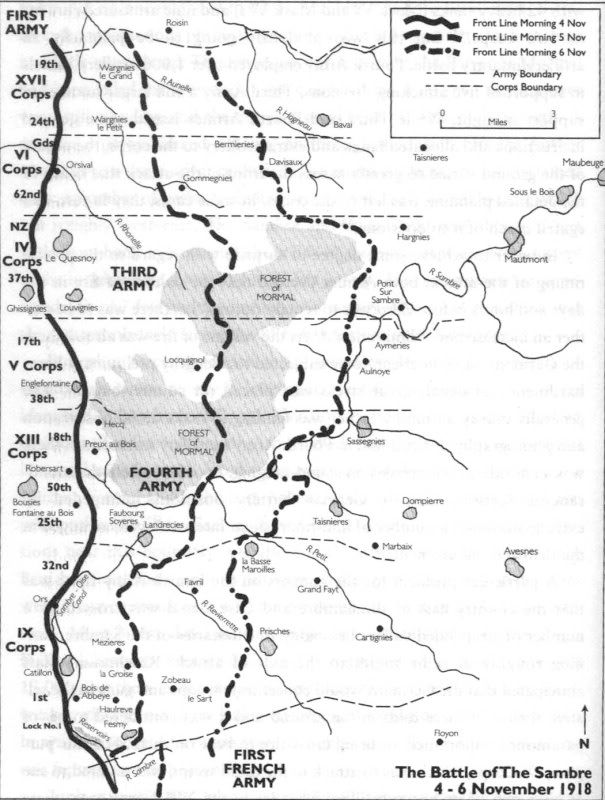
During those days, the 7th Northamptonshires held the line and were involved in actions such as the battles of the Hindemburg Line (September 12th to October 9th, 1918), The Battle of Cambrai of 1918 (October 8th and 9th), the Pursuit to the Selle (October 9th to 12th), and then in the final advance through Picardy, in the Battle of the Sambre. It was in the course of this action that George Swain was wounded (and quite likely Charles, too).

November 4th, 1918: The Battle of the Sambre starts
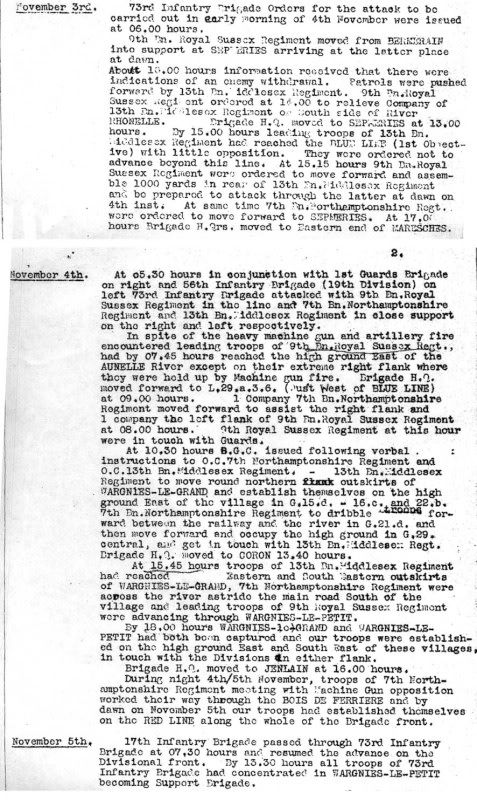
The day when the Battle of the Sambre started there was a thick groud mist, which, according to J.P. Harris, in his book "Amiens To The Armistice" (1998) was a fact which "tended to reduce casualties from machine-gun and rifle fire", by dusk, the XVII Corps (to which the 7th northants belonged), had taken all the planned objectives for the day, making an advance of 3 to 4 miles. You can get a helpful bird's view of the action from the Diary (WO 95/2217) of the 73rd brigade, (which comprised the 7th Bn. Northamptonshire Regiment, the 9th Bn. Royal Sussex Regiment and the 13th Bn. Middlesex Regiment) by clicking here and see a map of the battle by clicking here.

As far as the the ground view of events is concerned, here we have the account of these days the from the 7th Northamptonshires' War Diary:

November 4th 1918. Bermerain
B and D Companies were detailed as support to the 9th Bn Royal Sussex Regiment (73rd Brigade, 24th Division) who were to attack along the whole Brigade front from a line which had been established West of the Enlain-Villers Pol Road. Capt. A. Elliman was in command of D Company and supported right flank and Capt. B. Wright the left flank. These two Companies moved off at 3 am, crossed the river Rhonelle by bridges which had been put into position by A Company the night previous, and took their position by early morning. A and C companies remained in the positions occupied the previous night until 6 am and then moved to the rear of the general line of advance. The barrage commenced at 6 am and the Companies moved forward. D Company was caught in the Hun counter-barrage and a number of casualties were caused. The remainder were led onward and in time formed part of the front line. By 8 am they were on the high ground in front of Wargniers-le-Petit. Capt A. Elliman and 2/Lieut J. W. Tetley had both become casualties (wounded). B Company successfully eluded the counter-barrage on the left (N) flank and succeeded in establishing themselves in a position which dominated the small bridge over the river Aunelle. This bridge carried the main Enlain-Bavay Road which separated Wargniers-le-Grand and Wargniers-le-Petit and by concentrated Lewis Gun and rifle fire and by forward patrols they managed to keep it whole. The enemy was shelling the sunken roads and were sweeping the ridge with machine gun fire. The position, having become stationary, it was decided to relieve the pressure by outflanking both villages from the north. The 13th Bn Middlesex Regiment (73rd Brigade, 24th Division) was allotted Wargniers-le-Grand and the 7th Northamptonshire Regiment, Wargniers-le-Petit.

14.30 hours- A and C Companies were detailed for this duty. They were to cross by keeping their left on the main road and push through the village and then onward to the high ground East of it. C Company formed the front line under 2/Lieut. C. Pike and A Company under Capt. G. A. Williamson were in support. Machine gun fire was met with but overcome by grenades and rifle fire and both Companies established themselves well forward of the village. B Company now became support and D Company having been withdrawn from the front line went into reserve. The enemy began to shell the outskirts and roads leading to the villages which were inhabited by a fair number of French civilians. 50 prisoners were taken during operations.

Again, we don't get here a comprehensive picture, apart from the officers (mentioned by name) the casualties from the ranks are just given as an anonymous "number of casualties" in D Company. Since we know that George Swain pertained to B Company, it is undoubted that D company was not the only part of the battalion to suffer "a number of casualties", in fact, if we peer at the 73rd Ambulance's diary, we see the casualties for the three battalions and other divisional units amounted to 360 cases, roughly a tenth of the men involved (and that in the case that the battalions were at full establishment, and they were most probably not so, due to prior casualties duirng days of sustained fighting)


73rd ambulance's entry for November 4th(WO 95/2202. National Archives. Crown Copyright)

So here we have one more piece in the puzzle of Charles' war whereabouts. As the song says, who knows what the future holds, so I don't discard further little details coming up, each one a little miracle. One may debate about whether the gods exist or not, but miracles do happen!


This post is respectfully dedicated to those soldiers who, like Charles, were serving on November 11th, 1918, Saint Martin's day.

Bibliography
Apart from the already mentioned diaries, plus the books mentioned in the pages containing the known information, J. P. Harris' "From Amiens To The Armistice" (Brassey's, London 1998) has been a most helpful information resource about late 1918 events in the Western Front.

Acknowledgements
I'm deeply grateful to Mr. Stephen Beeby, who recently brought to my attention George Swain's record, and also to Mr. Martyn Smith, for all the continued help through the years relating the Huntingdonshire Cyclists