•  •  •  •  •  •  •  •  •  •  •  •  •  •  •  •  •  •  •  •  •  •  •  •  •  •  •  •  •  •  •  •  •  •  •  •  •  •  •  •  •  •  •  •  
We're campaigning for a Special DVD edition of "The Night of the Hunter": Join the cause!
•  •  •  •  •  •  •  •  •  •  •  •  •  •  •  •  •  •  •  •  •  •  •  •  •  •  •  •  •  •  •  •  •  •  •  •  •  •  •  •  •  •  •  •  

Sunday, October 18, 2009

Two number ones (and a number of quick ones)

As mentioned previously in another post, I'm not of the opinion that a position in a list is what makes a film great. Still, since there's people influenced by "umpteen best films" lists, I've got to say that they have its use... For one, they may attract the interest of filmgoers towards "oldies" and, well, help overcome their reluctance to watch films in Black & White, for instance.


In the particular case of Charles Laughton's "The Night of the Hunter", this may also give a measure of the growing reputation of the film which all but seemed doomed to oblivion when it was first released. I'm well aware that high-ranking places also usually draw the attention of Phillistines and Iconoplastas who'll raise hell just for hell-raising's sake (... or because the poor things have nothing better to do, tsk!)

"Ah! Je souris de me voir si haut dans cette liste..."

Anyway, here it goes: the British magazine The Spectator put "The Night of the Hunter" in the number one of their Best Films list. This was brought to my attention by a couple of fellow Laughtonians, who sent me this link by Roger Ebert commenting on the issue (and Ebert is a great appreciator of Laughton's only full opus behind the camera)... Not only this, for Time Out, the British entertainment weekly guide, also lists the film as the number one among first films of a director's career, which is considerable kudos to give, considering that they've listed as remarkable film debuts as "Citizen Kane", "Les Quatre Cents Coups" , "The Great McGinty", "Targets" or "L'Age d'Or" below Laughton's film.

I must say I get an extra kick of this recognition coming from the British press. Over the years, I've got the overall impression that Laughton, while certainly apreciated by the British public, wasn't as recognized by the British powers-that-be. But never mind... Charles may have not got titles nor royal honours, but sure he still gets lots of love... Worldwide!

On the light of this, it might be interesting to watch this little snippet from an American TV program (dated around february 1960):


"Guess who's playing Falstaff"

The host's final comment to Charles about the American public's affection is worth noting: Laughton certainly seems to feel at home, willing to charm and full of energy and projects: it's sad to realize he had barely a couple of years left to live (By the way: It's funny to listen to the blindfolded pannelists assume that any British-born actor has a title). It is intriguing to learn that there was a broadcast of the Stratford 1959 production of A Midsummer Night's Dream (with Charles playing Bottom) which was shown in America but not in the United Kingdom (hum... Why?!)

Pierre's Fablet "Night of the Hunter Project" has finally seen the light in a handsome CD distributed by Harmonia Mundi. This is just so you know, for, as you can imagine, the recording is truly worth of a post of his own, which I hope to do as soon as circs allow.

Those of you fortunate Laughtonians living in the vicinity of Chicago, Illinois, will be glad to learn that there's is a Laughton season going on there until December 3rd: here at evanevanevan.com you can read a nifty essay on Charles' career, as well as details about the screenings.

In the film releases front, I'm happy to announce that "The Bribe" is finally going to be on DVD, in the Warner Bros "Archive Collection", which, as some of you may know, is no regular DVD release, but one that works on customer's orders (you order it, and they make a digital copy for you). The bad side is... it's a Zone 1-only release which cannot be purchased by anyone living outside that geographical zone... In short, some genius at the top of the company think that, outside the north of America, nobody is interested in film classics.

(Note: if any kind American Laughtonian is willing to make an order for me, please send a message to this blog so we can make an arrangement, ahem)

Saturday, October 10, 2009

Why must we resist, Mr. Lory?

Prosecutor: Excuse me, Your Honor, I ask the courtroom be cleared.

Albert Lory: He's afraid, Your Honor. He's trying to deprive me of my last chance to speak. I know I am a condemned man. I know I will die. Are you going to let me speak, Your Honor, or are you afraid, too?

So, why must we resist, Mr. Lory?


Because though it increases our misery, it will shorten our slavery.

Thanks, Mr. Lory!

P.S.: Oh, by the way...Salutations to the guys of the Gestapo. Yes, I'm pretty aware you're reading this, too.

Tuesday, September 29, 2009

Sir Wilfrid, I need you!


Sir Wilfrid, adressing my mastah

I hope my fellow Laughtonians excuse me for not giving any signs of life for weeks, but things in the non-virtual world have kept my mind busy. Gloomy things. Gloomy thoughts. You'll forgive me the Off-Topic.

After weeks of spreading rumours, the powers that be at my workplace have gracefully announced that they're gonna give the axe to an undetermined number of employees. Over the last year, the management has asked us to make sacrifices, and so we've done and, cor, we've be compliant and as flexible as jelly bamboo, goodness knows. But this seemingly isn't enough, and they are seizing the current recession as an excuse to chop heads, à la Henry VIII.

In front of us hapless, amateurs but wilful representatives of our small company's workers, we'll have one of the most expensive, and mightiest law firms of Spain. We've been told that they have a fondness for raw meat, and I'm afraid that they're starving for workers' tartare.

If only we had at our side Sir Wilfrid Robarts, champion of the hopeless causes... But as Albert Lory, we'll have to be our own defenders.

God Almighty help us.

(Wish us luck, we're effing going to need it)

Wednesday, July 29, 2009

Spring blades

A knife cutting through a pocket. Fans of "The Night of the Hunter" are familiar with the image, arent they?


... Wait, I don't recall this frame from the film... What's wrong?

Quite simply, this hand isn't Robert Mitchum's but Lon Chaney's, and this frame doesn't belong to Charles Laughton's "The Night of the Hunter" (1955), but to Wallace Worsley's "The Penalty" (1920), which David Cairns commented upon on a post at Shadowplay. It was Mr. Cairns who mentioned the scene in the comments, and I was duly intrigued.

When he posted me the screen capture seen above, I was truly awed, but let's recap and go back to "The Night of the Hunter"


Well, we have Preacher Powell attending a Burlesque show... Not that he likes it, in fact, he seems to find it rather disgusting.


So he clutches his left "Hate" fist, hides it inside the pocket and... "Snikt!"

Mr. Cairns believes that the scene in "The Penalty" might have inspired this one from "The Night of the Hunter", and it doesn't seem unlikely... Didn't the gardener tell Brecht "I steal from all places"?

Such a scene, by the way, is not in Davis Grubb's original novel, the most similar situation there being a scene prior to preacher's detention, in which he is ready to loosen the blade of his knife as a prostitute proposes to him in a brothel... One imagines that the whorehouse was transformed in the film into the -no less sleazy- Burlesque show to avoid censorship, but it is striking that the censor didn't object to the gleaming, phallic knife cutting through the clothes. The scene follows faithfully the definitive version of the script, and, from pictorial evidence, Laughton took great care in directing Mitchum's hands there.


Good direction is in the tiny details

Back to "The Penalty" , the knife cutting through Chaney's pocket is suggestively menacing, though it lacks the connection between Eros and Thanatos so strongly stated in Laughton's film. At any rate, this scenes reminds us of how "The Night of the Hunter" recovered the powerful storyteluing of silent movies, a power which was gone with the sound.

We could conclude that there might be a Worsley & Chaney connection with Laughton beyond "Notre-Dame de Paris"

Wednesday, July 01, 2009

Here's looking at you


Charles Laughton is often referred to as an insecure fellow. I'd like that those thinking this way would take this image into consideration. He stares at you with a confident stance, it could be said, in fact, that he's challenging the viewer.

The image is from 1932, and quite likely (from the haircut) near the time he was working in "Island of Lost Souls". At this moment, he's the newbie who's holding Hollywood in awe. He doesn't hesitate to hold for his vision of the character he's playing, even if he has to hold it against a Hollywood big fish like Cecil B. de Mille, and he's only been in town for a few months.

He had arrived to California with an agreement with Paramount to work in a couple of films a year, so film work didn't keep him from working at the British stage. When he returned to London some months afterwards, he had shot six pictures. For Paramount, but also for Universal and Metro-Goldwin-Mayer. By the time he was about to work in his fourth film, his wife Elsa Lanchester (often referred as his bolder better half) had returned to London in a seizure of homesickness. Of course, she was also understatably frustrated about Hollywood's myopia, who back then perceived her just as the new employée's wife. Elsa had a protective attitude towards Charles, though it is evident that he did reasonably well when he was left alone in the Tinseltown wilderness for the months he was without her. He returned to London able to say he had made it.

You should know that, a mere seven years ago, one of 1932 Hollywood sensations had -finally- convinced with his family of hoteliers to allow him to give a try at becoming a professional actor. They, of course, believed that Charles would return from his foolish adventure soon enough, tail between legs, to assume his destiny as an hotel manager. But Charles would never again be an hotelier, and his mother and brothers would gape in disbelief when he not only eventually became a professional actor, but got to play leads in the West End.

What was he thinking when the photographer shot this image? Maybe "And tou thought I wouldn't make it, eh"?

I'd like to think he was thinking "Here's looking at you!"

Insecure you said?

...Right, this was again the Charlie Birthday Special, and I'd like to finish it with a few goodies for you all.

I generally bookmark CL-related links for when I have to deal with an specific film or play in the -near or far- future, but I have a couple of Laughton celebrations in the blogosphere which I'd like to bring to your attention: one is by Matthew Coniam at Movietone News , a celebration of the actor focusing in his pre-code films, and the other is by Joseph "Jon" Lanthier at Bright Lights After Dark, asking the oil painters of the world to unite. Both post will be treat to any Laughtonian.

Talking about treats, I'd like to mention Criterion's recent DVD release of David Lean's "Hobson's Choice" (Zone 1), coming, like every DVD release should, with appetizing extras. If that weren't enough, Criterion's website provides a number of very readable articles on Laughton and the film: Graham Fuller's "Charles Laughton: Size matters" , Armond's White"Hobson's Choice: Custom-Made" , and links to press notes.

Also, Criterion's kid sister company, Eclipse, has released a special boxset, "Alexander Korda's Private Lives" which includes "The Private Life of Henry VIII" and "Rembrandt". Again, a Zone 1 release, though, as usual in Eclipse's releases, without extras. Again, we have at their website an interesting article about this release as Michael Koreski's. There are nice external reviews, too, such as Jon Lanthier's here and here ("Korda cudgel"... XD), Dave Kehr's at the New York Times (these and some other comments on the subject can be found linked by David Hudson at IFC.com

And that's not all! In the last months, a couple of interesting books new books about "The Night of The Hunter", one is "La Nuit du chasseur - Une esthétique cinématographique" by Damien Ziegler, and the other "The Night of the Hunter: A Biography of a Film" by Jeffrey Couchman. I'll post about them in the near future, promise.

Now you may blow the candles.

Tuesday, May 26, 2009

¡¡Camarero, una de gambas...

... con gabardina!!


Sorry for the lame pun, which probably will only be understood by Spanish speaking visitors anyway (and possibly just the Peninsular ones). See, gratuitous celebrity advertising existed long before the Beckhams were even born, the difference being that any member of this cast and director trench coated group actually had a talent beyond that of posing for an advert.

(I'm curious about the occasion: did they shot the picture on the set of Advise and Consent? Did they pose all together as a group or separately? Funny seeing Otto Preminger as a model there, too)

Anyway, I'm posting this wee bit just to comment that Matheww Coniam of Movietone News just gave me a friendly blogger award:


Huh... Thanks Mr. Coniam, Im so touched *sob*... All right, I'll spare you the three-hour long thankful speech in which I emote wildly and mention all my relatives -up to cousins in the seventh degree-. I have accepted the award mostly because I don't have to select/tag any particular number of fellow bloggers... (To those friendly bloggers who have given me an award in the past: believe it or not, I'm STILL making my mind as to which bloggers I should select to pass the award!).

That I don't have to pass the awardto anyone it doesn't mean that I won't: If you are in my blogroll feel free to claim the Friendly Blog Award from me ;D

Wednesday, May 13, 2009

White Rabbit


We'll have some fun when the clock strikes one

Elsa, about 74:
The passage of time reaches a high speed as you get older. (...)You learn that life is not long enough to plant a tree. It will grow, but you will never see it become a great tree. You feel like the White Rabbit in Alice in Wonderland–No time, no time.
(...)And at this point I realize what Charles must have felt from his childhood on. No time, no time.

Charles, about 61:
When I was in my early twenties, I was at our farm on the Yorkshire Moors in England. My Mother, my brother Tom, and my cousin Molly and I were looking at a sow with a litter of young pigs: I noticed that each of us was looking at the scene differently. My mother was thinking "What a nasty smell!" My brother Tom was thinking how much the piglets would market for when they were fattened up. My cousin Molly was thinking "How sweet! A mother and her babies."

And I was watching my family tick.

In the picture above, Charles and Elsa as seen in a 1944 domestic vignette. Elsa's dress makes her look slightly Peter Pan-ish. The inlaid wood clock from their Art & Antiques collection she's winding is 350 years old. Elsa looks -as the press release note puts it- quite industrious: for some reason, I can easily picture her building up a set of EEK!EA shelves, Allen key in hand (my guess is that she'd be more efficient at that than Charles would).

And Charles? Well, Charles is watching the clock tick.

In the background you can guess a piano, topped over by a pre-Columbian jar, and a branch in bloom by the window.

The place is the Laughtons much loved house at the Pacific Palisades in which they lived through the 1940s, that of the luxuriant garden on the cliff overlooking the Pacific, eulogized by Bertolt Brecht:
(...) Leider ist der schöne Garten, hoch über der Küste gelegen
Auf brüchiges Gestein gebaut. Erdrutsche
Nehmen ohne Warnung Teile plötzlich in die Tiefe. Anscheinend
Bleibt nicht viel mehr Zeit, ihn zu vollenden.


Edit: Andy most kindly posted me the English language version Bert Brecht's full poem (Thanks! ;D). Anyone of you out there have the full German Version?

GARDEN IN PROGRESS

High above the Pacific coast, below it
The waves' gentle thunder and the rumble of oil tankers
Lies the actor's garden.

Giant eucalyptus trees shade the white house
Dust relics of the former mission.
Nothing else recalls it, save perhaps the Indian
Granite snake's head that lies by the fountain
As if patiently waiting for
A number of civilizations to collapse.

And there was a Mexican sculpture of porous tufa
Set on a block of wood, portraying a child with malicious eyes
Which stood by the brick wall of the toolshed.

Lovely grey seat of Chinese design, facing
The toolshed. As you sit on it talking
You glance over your shoulder at the lemon hedge
With no effort.

The different parts repose or are suspended
In a secret equilibrium, yet never
Withdraw from the entranced gaze, nor does the masterly
hand
Of the ever-present gardener allow complete uniformity
To any of the units: thus among the fuchsias
There may be a cactus. The seasons too
Continually order the view: first in one place then in another
The clumps flower and fade. A lifetime
Was too little to think all this up in. But
As the garden grew with the plan
So does the plan with the garden.

The powerful oak trees on the lordly lawn
Are plainly creatures of the imagination. Each year
The lord of the garden takes a sharp saw and
Shapes the branches anew.

Untended beyond the hedge, however, the grass runs riot
Around the vast tangle of wild roses. Zinnias and bright
anemones
Hang over the slope. Ferns and scented broom
Shoot up around the chopped firewood.

In the corner under the fir trees
Against the wall you come on the fuchsias. Like immigrants
The lovely bushes stand unmindful of their origin
Amazing themselves with many a daring red
Their fuller blooms surrounding the small indigenous
Strong and delicate undergrowth of dwarf calycanthus.

There was also garden within the garden
Under a Scotch fir, hence in the shade
Ten feet wide and twelve feet long

Which was as big as a park
With some moss and cyclamens
And two camelia bushes.

Nor did the lord of the garden take in only
His own plants and trees but also
The plants and trees of his neighbors; when told this
Smiling he admitted: I steal from all sides.
(But the bad things he hid
With his own plants and trees.)

Scattered around
Stood small bushes, one-night thoughts
Wherever one went, if one looked
One found living projects hidden.

Leading up to the house is a cloister-like alley of hibiscus
Planted so close that the walker
Has to bend them back, thus releasing
The full scent of their blooms.

In the cloister-like alley by the house, close to the lamp
Is planted the Arizona cactus, height of a man, which each
year
Blooms for a single night, this year
To the thunder of guns from warships exercising
With white flowers as big as your fist and as delicate
As a Chinese actor.

Alas, the lovely garden, placed high above the coast
Is built on crumbling rock. Landslides
Drag parts of it into the depths without warning. Seemingly
There is not much time left in which to complete it.

Tuesday, March 31, 2009

Marie Magdalene, a remarkable woman


Sir Wilfrid peeps at Christine Vole while she puts on some lipstick

Charles Laughton's concern and/dissapointment about his lack of conventional good looks has almost become a legendary common place about the man, even though, as I mentioned in another post, he coped with it better than it is generally assumed.

In fact, while he could despair at the fact that he might look into a mirror to find his reflection, instead of Gary Cooper's or Johnny Weissmuller's, he certainly appreciated when someone contradicted his views on his own apperance. Let Charles himself tell us one of such instance:
When I was rehearsing in "on The Spot" (1930), Edgar Wallace's play, in which I had to wear smart clothes and go around the stage kissing the women, I came home one night in a state of despair, sullen and nasty, and said to Elsa (Lanchester): 'I know they won't stand for this. I've got a face like an elephant's behind, and in this play I've got to do the big sex act'. She turned tround on me like the proverbial tiger-cat and whipped out: 'How dare you presume you're unattractive! Hold your shoulders back, keep your head up and smile, so I can keep my head up with other women'. Can you beat it? I owe her plenty.

Despite the fact that he was gay, Laughton wasn't unappreciative of women, and many women (that is, apart from Elsa) liked him in turn: I have come across many warm records of his friendship and appreciation of fellow performers and/or co-workers like Ruth Gordon, Bette Davis, Maureen O'Hara, Agnes Moorehead, Deanna Durbin, Shelley Winters, Ava Gardner, Belita, and Lillian Gish to mention a few. Merle Oberon or Myrna Loy would recall Laughton raising their own self-steem with gracious compliments. And, we have to say, Charles could be very perceptive describing women, but let's hear it from Night of the Hunter's author Davis Grubb :
I once remarked that Marlene Dietrich had always struck me as a strange and bewitched kind of genius. 'Yes,' Laughton sighed. 'There is a quality about Marlene that rather suggests jeweled whips'

Under such quizzical praise of the German star lies genuine admiration, and there's an extra element here, for beyond the professional appreciation, Laughton also owed a big one to Marlene. In Elsa's account:
"Knight Without Armour" was started at Denham (Studios) just before we finished "Rembrandt", and so we ran into Marlene Dietrich quite a lot. She is to me, and to Charles, I think, one of the few undisappointing film stars off– a pleasure to pass in a passage. One of the greatest moments in my life was when she said to a pressman that she would rather act a love scene with Charles than with any other actor in the world. This statement made headline news in an evening paper. When Charles read it he was wildly flattered, he threw the newspaper in the air and cheered himself. I was no lesss delighted by the indirect compliment to me. We had a drink on it.
I somewhat regret that Marlene didn't get her wish fulfilled. Back then, her only link with Charles' work, was a sadly star-crossed project: While working in England, Miss Dietrich suggested Alexander Korda to give work to her former mentor Joseph Sternberg, and Korda gave Sternberg the job of directing "I, Claudius". Yes, "I, Claudius". Ouch.

Years later, Laughton and Dietrich would finally work together, not in any romantic scene, but certainly in good spirits in "Witness for the Prossecution". Where Laughton's stubborn Sir Wilfrid memorably confronts Dietrich's enigmatic, ice-cool Christine Vole in order to save poor Tyrone Power from the hangman's noose. Dietrich, who was helped by Laughton in rehearsals (I don't go into detail as to not spoil certain elements of the plot), wrote fondly of Laughton in her memoirs.

And to end with this little account of the mutual admiration society of Charles and Marlene, I'll end with a further (and intriguing) comment by Miss Lanchester about Miss Dietrich:
After meeting her in a Denham corridor one morning, Charles told me that in private life she had the art of casually putting on a very little makeup that looked slightly smeared, as if she had just got out of bed after a night of it. Obviously, these two should have got together somehow.

Hum... I wonder if that would explain Laughton's sighing when talking about Dietrich to Davis Grubb.

Oh, well, maybe he just got the story from Sternberg.

Note on sources:
Quotes are sourced from Elsa Lanchester's autobiographies "Charles Laughton and I" (1938) and "Elsa Lanchester Herself" (1983) and Preston Neal Jones' most commendable "Heaven and Hell to Play With: The filming of the Night of the Hunter" (2002)

Thanks!:
This is one of the many posts I had half baked in the oven, so to say. I shouldn't have dared to give it the final push towards posting if the Self Styled Siren had not devoted a post on Marlene's lipstick and had started a MarleneFest on her own blog

Sunday, December 07, 2008

Hunter Jazz, and a list of one hundred films

Just a few posts before, I talked about a project by Mr. Pierre Fablet and a ensemble of jazz musicians: a jazz concert inspired by "The Night of The Hunter", and Walter Schumman's score for it.

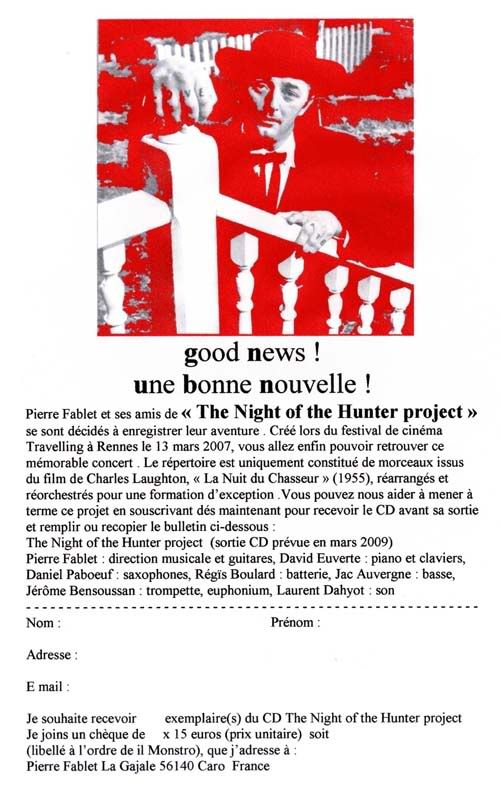
The good news is that Mr. Fablet's project to record the concert is going ahead. To that end, he has opened a subscription: anyone who'd like to contribute to make the CD release possible can participate (For those of you interested click here for a subscription leafleet).

I hope the CD becomes a reality soon and I can make a post about it ;D

Second!
At the time of its release, one of the few appreciative reviews that "The Night Of The Hunter" received was one by Francois Truffaut. Truffaut sadly realized that Laughton's original parable was bound to be too conventional for Hollywood's staple: while praising Laughton's film-making as having the courage "to knock over a few red lights and some traffic cops in his unusual film. It makes us fall in love again with an experimental cinema that truly experiments and a cinema of discovery that, in fact, discovers" he also predicted that "screenplays such as this are not the way to launch your career as a Hollywood director. The film runs counter to the rules of commercialism: it will probably be Laughton's single experience as a director".

Recently, a group of 78 critics were asked by Cahiers du Cinema (the renowned French magazine to which Truffaut used to contribute) to vote for their favourite films: the result lists one hundred films, of which Laughton's "The Night Of The Hunter" ranks second, tied there with his good friend Jean Renoir's "La régle du jeu" (I just love that tie, particularly since Charles and Jean's joint 1943 effort is what made a Laughtonienne out of me).

I've read a number of online comments about that list which question the selection, and of course a list of just one hundred film, however remarkable, is bound to leave a good number of films outside, in fact a list of a thousand films would also undoubtedly leave out many films of worth. Maybe I'd add more films to a personal list, films by Mikio Naruse, Jose Luis Berlanga, Isao Takahata, Alexander Mckendrick, Norman MacLaren, Marco Ferreri, Albert Lewin, Hayao Miyazaki, Powell & Pressburger, Pedro Almodovar, Preston Sturges, Bertrand Tavernier or Mitchell Leisen, among many others, but then there is such a lot of films I still have to see that... well, I'd probably leaving out a lot of excellent films as well!

Anyway, I don't think that the list was meant to be an "absolute" one, those critics voted their their favourites, and wether you agree or not with their choices, I don't see bad films there. And... well, yours truly is awfully pleased that "The Night of the Hunter" made it number two ;p

Notes
(1) Truffaut's review for "The Night Of The Hunter" is published in an enjoyable anthology of his reviews "The Films In My Life" (Originally published in French as "Les films de ma vie". I might as well mention that you should be able read the english version of the review thanks to the "look inside" search facility).

La edición castellana de este libro, "Las películas de mi vida" se publicó en 1976 por Ediciones Mensajero (Bilbao). Por si no la pudiérais localizar ni de segunda mano ni en bibliotecas... click, click

Ackowledgements
My thanks to Olivier for first giving me the news.

Tuesday, November 11, 2008

George Swain, wounded ninety years ago


Ninety years ago, on November 4th, a week before the armistice, Private George Swain was wounded in the head on the Western front, and repatriated to England to heal his wound. Some time later, his claim for a war pension was declined, as the examiners considered that he had fully recovered from his injury, and wasn't incapacitated by it. Even though George's claim didn't succeed, I'm glad he tried, because his case was filed among the War Pension files, and that file, unlike his service record (one of the many to dissapear during World War Two as a result of enemy bombing), has survived to our days.

And how relevant, you may wonder, is this for this blog? Well, quite so, for George Swain was a pal of Charles Laughton during the First World War.

By summer 1918, George Swain was serving, as Charles, with the 2/1st battalion of the Huntingdonshire Cyclists (both in D company). Along with Charles and many other boys in that Battalion, he was drafted to reinforce other units in France. By the earliest regimental number mentioned in his War Pension Record, it is quite likely that George, as Charles and John Agar (another boy in D company), received his early training at the 87th Training Reserve Battalion at Catterick. As at least Charles and another two men in that list, Swain was a Yorshireman, which gives you a picture of how manpower was dealt with at this late stages of the war: in its early stages, men were keen to enlist, and serve, in their "county" regiments, but by 1918 such sentimental choices just weren't available to the young conscripts, who were just posted to wherever reinforcements were needed... Thus you could have these Yorkshire boys, going from the (Conscription) Training Reserve Battalions right after being called up, then being posted to a Huntingdonshire regiment (Territorial) to guard the coast of Lincolnshire, and then again. posted (for the records) to the 4th Bedfordshires (a Regular battalion), and then serving at the front in France with the 7th Northamptonshires (a "Kitchener" or New Army battalion)... That's running the whole gamut, if you ask me.

A bit of background: Desperately Seeking Charles' War Record


Charles' Medal card...


...And Charles' entry in the Medal records, which fortunately mentioned the battalions of the regiments he was allocated to, except the Huntingdonshire Cyclists, sadly not mentioned

When, years ago, I went to London to -among other things- try to find Charles' war record, I found out that it wasn't among those which survived the World War Two bombings. While I knew that this was likely, I couldn't help feeling dissapointed. But along with disappointment came an idea... What would came if I checked medal records for people with numbers correlative to Charles'? As I checked some 100 numbers over and under Charles' in the two regiments mentioned in his Campaign Medals card, I found out there was a pattern... Could these men whose numbers and regiments were coincident with Charles' have served in the same battalions together?

The answer was yes. And this was confirmed when Mr. Martyn Smith (the Huntingdonshire Cyclists' dedicated historian, and keeper of the afore-linked -and excellent- website on them) most kindly sent me copies of some of the surviving Battalion Orders of the 2/1st Huntingdonshire Cyclists, where, among other things, Charles was mentioned, along with other boys, as part of a draft being sent to the front on August 9th, 1918 (that list is also afore-linked). This was quite the Rossetta Stone of our research, as it provided both the confirmation of Laughton having been at the Huntingdonshire Cyclists (so far we had only an old picture with his badge, plus vague mentions of it in biographies), and also the date when he was drafted to France. With this information on our hands, we proceeded to elaborate a webpage containing what we knew so far about Charles' Great War service (with some related links for context, etc.). There were, of course, many questions remanining... I later found mention by Charles, scattered in old interviews, about his serving with the 7th Northamptonshires during the war, which further confirmed the medal card data, along with a few excerpts from an exchange of letters with an old comrade from the battalion.

Still, many questions remained... When did Charles reach the frontline? What about the 4th Bedfordshires? When was he gassed? etc, etc...


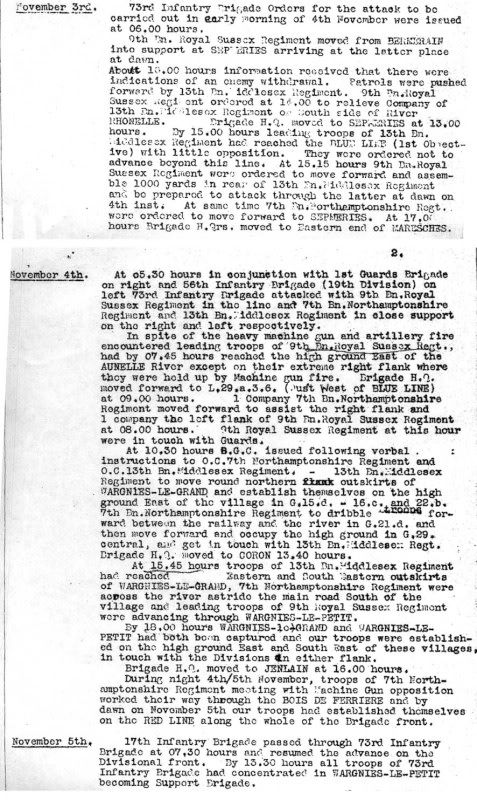
Two relevant pages of George Swain's pension record.

At least one of these questions was answered when Mr. Stephen Beeby, a dedicated Great War researcher from Cambridgeshire, reached me with excellent news. He had found George Swain's Pension record, which mentioned George's itineraire through units during his war service... Of course there must be divergences with Charles' service, among them the fact that George's scalp wound caused him to be repatriated to England, while Charles, as a gas casualty, quite surely had to heal on a French hospital after receiving first aid. It is interesting that the War Diary of the 73rd Ambulance (WO 95/2202), caring for the wounded men of the 73rd Brigade (24th Division, Third Army), to which the 7th Northamptonshires belonged, contains a diagram of how to build a centre to deal with gas casualties, which helps to picture how Charles may have received his early treatment (You can see a better-resolution image, plus more related details here


How the 73rd ambulance organized a centre to deal with gas cases of every type (WO 95/2202. National Archives. Crown Copyright).


The Last Hundred days
Knowing already the date when Charles left England, Thanks to George Swain's War Pension record, we also know that the draft of Huntingdonshire Cyclists disembarked in France on August 10th, 1918, then was "posted to 4th battalion for records"... which clears the 4th Bedfordshire question, as this reveals that those boys were there just for administrative reasons, not even changing their regimental numbers in the process. In fact, on August 12th, they are definitely allocated -and given new regimental numbers- to the 7th Battalion, Northamptonshire Regiment. Thus Charles and Co. were 4th Bedfords for just a couple of days, and just for the records.

The draft seems to have spent little time in "transit" camps in the coast, like the well-known, and enormous, Etaples camp, instead, they were sorted quite quickly to the 24th Division's reinforcements' camp, just eight days after landing in France, where one imagines them getting an extra bit of training to prepare them for front-line action, and by the September 8th, the draft finally joins the 7th Northamptonshires. As you can see in the battalion's diary here, those days were spent in training and reorganization at Marqueffles Farm (not far from Lens), plus accomodating the newly arrived (sadly, the arrival of the new draft is not even mentioned in the diary: one regrets that the officer in charge of the diary was not too exhaustive in his recording of the facts).

Incidentally, all this is rather consistent with Elsa Lanchester's statement, in her 1938 biography "Charles Laughton and I" of Charles being sent "straight to the front", and therefore, it is likely that the mention of Charles being gassed "one week before the war" is accurate as well, and not just a foggy "family tradition". Among other things, because it was on the November 4th when George Swain was wounded, in the course of a battle in which the 7th Northants were involved, but we'll come back to that later.

Charles' draft reached the Battalion in time to take part in the campaign that has become known as The Last Hundred Days, in which, after the Battle of Amiens, the allies advanced steadily, at a pace which spectacularly outspeeded the gains of battles in previous years. The daily casualty rate of the British was higher than those of either the Battle of the Somme or Third Battle of Ypres (Passchendaele), if not as high as that of the Battle of Arras.

During those days, the 7th Northamptonshires held the line and were involved in actions such as the battles of the Hindemburg Line (September 12th to October 9th, 1918), The Battle of Cambrai of 1918 (October 8th and 9th), the Pursuit to the Selle (October 9th to 12th), and then in the final advance through Picardy, in the Battle of the Sambre. It was in the course of this action that George Swain was wounded (and quite likely Charles, too).

November 4th, 1918: The Battle of the Sambre starts
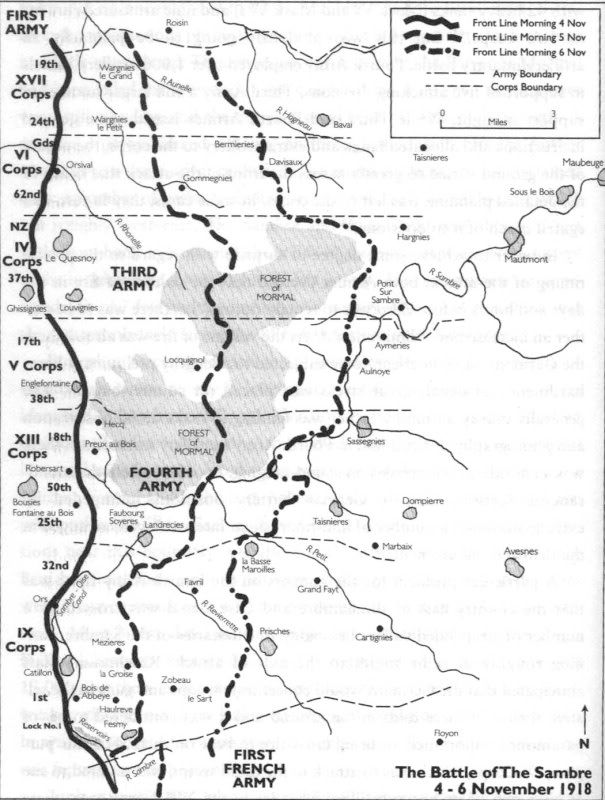
The day when the Battle of the Sambre started there was a thick groud mist, which, according to J.P. Harris, in his book "Amiens To The Armistice" (1998) was a fact which "tended to reduce casualties from machine-gun and rifle fire", by dusk, the XVII Corps (to which the 7th northants belonged), had taken all the planned objectives for the day, making an advance of 3 to 4 miles. You can get a helpful bird's view of the action from the Diary (WO 95/2217) of the 73rd brigade, (which comprised the 7th Bn. Northamptonshire Regiment, the 9th Bn. Royal Sussex Regiment and the 13th Bn. Middlesex Regiment) by clicking here and see a map of the battle by clicking here.

As far as the the ground view of events is concerned, here we have the account of these days the from the 7th Northamptonshires' War Diary:

November 4th 1918. Bermerain
B and D Companies were detailed as support to the 9th Bn Royal Sussex Regiment (73rd Brigade, 24th Division) who were to attack along the whole Brigade front from a line which had been established West of the Enlain-Villers Pol Road. Capt. A. Elliman was in command of D Company and supported right flank and Capt. B. Wright the left flank. These two Companies moved off at 3 am, crossed the river Rhonelle by bridges which had been put into position by A Company the night previous, and took their position by early morning. A and C companies remained in the positions occupied the previous night until 6 am and then moved to the rear of the general line of advance. The barrage commenced at 6 am and the Companies moved forward. D Company was caught in the Hun counter-barrage and a number of casualties were caused. The remainder were led onward and in time formed part of the front line. By 8 am they were on the high ground in front of Wargniers-le-Petit. Capt A. Elliman and 2/Lieut J. W. Tetley had both become casualties (wounded). B Company successfully eluded the counter-barrage on the left (N) flank and succeeded in establishing themselves in a position which dominated the small bridge over the river Aunelle. This bridge carried the main Enlain-Bavay Road which separated Wargniers-le-Grand and Wargniers-le-Petit and by concentrated Lewis Gun and rifle fire and by forward patrols they managed to keep it whole. The enemy was shelling the sunken roads and were sweeping the ridge with machine gun fire. The position, having become stationary, it was decided to relieve the pressure by outflanking both villages from the north. The 13th Bn Middlesex Regiment (73rd Brigade, 24th Division) was allotted Wargniers-le-Grand and the 7th Northamptonshire Regiment, Wargniers-le-Petit.

14.30 hours- A and C Companies were detailed for this duty. They were to cross by keeping their left on the main road and push through the village and then onward to the high ground East of it. C Company formed the front line under 2/Lieut. C. Pike and A Company under Capt. G. A. Williamson were in support. Machine gun fire was met with but overcome by grenades and rifle fire and both Companies established themselves well forward of the village. B Company now became support and D Company having been withdrawn from the front line went into reserve. The enemy began to shell the outskirts and roads leading to the villages which were inhabited by a fair number of French civilians. 50 prisoners were taken during operations.

Again, we don't get here a comprehensive picture, apart from the officers (mentioned by name) the casualties from the ranks are just given as an anonymous "number of casualties" in D Company. Since we know that George Swain pertained to B Company, it is undoubted that D company was not the only part of the battalion to suffer "a number of casualties", in fact, if we peer at the 73rd Ambulance's diary, we see the casualties for the three battalions and other divisional units amounted to 360 cases, roughly a tenth of the men involved (and that in the case that the battalions were at full establishment, and they were most probably not so, due to prior casualties duirng days of sustained fighting)


73rd ambulance's entry for November 4th(WO 95/2202. National Archives. Crown Copyright)

So here we have one more piece in the puzzle of Charles' war whereabouts. As the song says, who knows what the future holds, so I don't discard further little details coming up, each one a little miracle. One may debate about whether the gods exist or not, but miracles do happen!


This post is respectfully dedicated to those soldiers who, like Charles, were serving on November 11th, 1918, Saint Martin's day.

Bibliography
Apart from the already mentioned diaries, plus the books mentioned in the pages containing the known information, J. P. Harris' "From Amiens To The Armistice" (Brassey's, London 1998) has been a most helpful information resource about late 1918 events in the Western Front.

Acknowledgements
I'm deeply grateful to Mr. Stephen Beeby, who recently brought to my attention George Swain's record, and also to Mr. Martyn Smith, for all the continued help through the years relating the Huntingdonshire Cyclists

Sunday, October 26, 2008

Star of the month in November at TCM (2)

Well, well... Here we have at last TCM's list of the films that lucky North Americans shall be able to watch in November, when our dear Charles shall be starring on that channel for a month.

Of these 18 films there are some unmissable by anyone who wants to know where Laughton's prestige comes from, some whose inclusion is questionable, and some which are inexplicably absent. Let's comment briefly on them.


Our lad Charles in a beautiful still taken during his early Hollywood days (Fellow Laughtonian Alceo has contributed with this wonderful 1932 picture from his collection)

Of these 18 features, we have two classics directed by Korda: his filmmaking may have become a bit dated, but Charles' performance as the Tudor king in The Private Life of Henry VIII is still the gold standard on the character (despite the recent "sexy Tudors on sweaty T-Shirt" trend), and his Rembrandt remains a sensible portrait of the struggles of a creator.

Despite recent historical revisionism depicting Captain Bligh as the hero of the story, Laughton's portrayal in Mutiny on the Bounty has connections with the real man: If the real Mr. Bligh was not the tyrant depicted in Nordhoff and Hall's novel, He was, as Laughton's Bligh, an excellent sailor (something quite forgotten in some later versions), a man isolated from his subordinates and crew, and a poor manager of human resources with an explosive temper. The real Bligh also had those bushy eyebrows ;p

Welcome are also the tyrannical Victorian father he plays in The Barrets of Wimpole Street, where he managed to manoeuvre past the Hays Code, by suggesting the more unwholesome aspects of father Barret's overprotectiveness of his daughter Elizabeth Barret, without the need of explicit dialogue. And his memorable Quasimodo in The Hunchback of Notre Dame, which he makes trascend into a powerful metaphor of human suffering.

We also have his inimitable Sir Wilfrid Robarts Witness For The Prosecution, a man seriusly concerned with Law and justice, in spite of his unlawful penchant for smuggling forbidden pleasures. We'll also see him in a court in a minor Hitchcock, The Paradine Case as a corrupt, ruthless and concupiscent judge. We also have an earlier joint effort with the master of suspense, Jamaica Inn , again, it may not be a top-notch Hitchcock, but it has a suitably dark atmosphere, and an over-the-top, and fairly enjoyable, performance by film producer Laughton.

Lesser known movies and parts, but fairly worth of re-discovery, are given a chance. Among them we have the film version of the stage success that brought Charles to Hollywood, Payment Deferred, a film which certainly lets you know that it is based on a play, but Laughton's clerk which commits murder, in spite of being quite unsuited for crime, is a fairly strong composition. There is also his supporting role, and first Hollywood work, as a Northern tycoon in James Whale's riotously bizarre The Old Dark House, which is both the paragon and the parody of the "haunted house" genre. The tropical noir The Bribe, in which he plays a small-time briber with bad feet, is a film, and a performance, worth re-discovering. And Captain Kidd may lack the lavish production values of Mutiny on the Bounty, but certainly has a strong central performance.

Surprisingly in!
As for some others, I find the TCM selection to be a bit odd at points, particularly considering that this monthly homage lacks some legendary performances, I mean, there is fun and charm in The Canterville Ghost, but it still makes you think what a film could have resulted if MGM had not watered down the original story by Oscar Wilde with circumstancial war propaganda and coarsened it with squaddy jokes (Think, for instance, in The Ghost and Mrs. Muir).

Young Bess, is posh -but not terribly exciting- costume drama, which I bet has been included to compare Laughton's performance as Henry VIII with his Oscar-winning performance of 1933. And one wonders why Salome is there: it is one of those films of the Somniferous Bible Epic genre, and not even Laughton's Herod can shake it up... I wonder why they don't show Cecil B. De Mille's The Sign of the Cross, instead: It's full of saucy pre-code naughtiness, bizarre fights at the Roman circus, and Claudette Colbert's Poppaea and Laughton's "wild Wilde Nero" (as Elsa Lanchester fittingly put it) really nail their characters (As with Henry, Laughton's Nero is pretty much the Nero to end all Neros: Peter Ustinov in Quo Vadis was like an Ursuline nun in comparison)

But when one sees that turkeys like Stand By For Action and The Man From Down Under, films only suitable for a Laughton completist (and a very hardened one,) are included in a 18-film season (out of a filmography of more than 50), the reason is clear: TCM is programming what he's got in its stock, and The Canterville Ghost, Young Bess, Stand By For Action are all MGM productions... still, how far are these from The Barrets of Wimpole Street or Mutiny on the Bounty!! The reason for this is, in his thirties' films for MGM, Laughton worked for Irving Thalberg, an intelligent producer who had more appropiate ideas as to what to do with Laughton's talent than Louis B. Mayer. I have read that Mayer kept Laughton under contract at MGM out of respect for the late Thalberg, who was a friend of Charles. Yet Mayer was evidently at a loss of what to do with Laughton, otherwise, one can't understand how he miscast him in parts like the old Aussie warrior of The Man From Down Under (a part and film Laughton woefully -and adequately- described to a friend as "You Can't Keep The Wallace Beery Tradition Down"), or the old Admiral which becomes suddenly obsessed with obstetrics in Stand By For Action, which Laughton has left no option but to play in an avant-la-lettre Monty Pythonese fashion.

Honest, rather than including these last two, I'd rather go for the rarely screened Mayflower productions Vessel of Wrath/The Beachcomber and St. Martin's Lane/Sidewalks of London , or some rather good performances of Laughton in anthology films like If I Had a Million, Tales of Manhattan, O'Henry's Full House or, why not? recover the long-lost-in-some-vault The Blue Veil.

I won't extend my criticism, however, to Abbott and Costello Meet Captain Kidd, Hey! it's an Abbot and Costello film... You won't expect something like The Seventh Seal, won't you?

Actually I think that it makes for a fun double bill with Captain Kidd, and Laughton admired Lou Costello and wanted to work with him. You may consider it a silly movie, but I don't think it's actually that harmful... If you ask me, as far as Laughton doing comedy goes, I'd rather see him in Abbott and Costello Meet Captain Kidd than in Hobson's Choice... Oh, I know this may sound blasphemous to some of you (so here I'm rushing to my artillery-proof concrete parapet), but I have to confess that my feelings about the David Lean film are quite similar to SImon Callow's, or to what Groggy Dundee says in his blog .

Surprisingly out!
Now, If I have complained about the inclusion of some films, it is because I feel they are stealing room to some really memorable performances which are let out... I suppose that the "films in stock" thing is the only explanation to that, but it still hurts that we have Stand By For Action, but lack This Land Is Mine , Island of Lost Souls , Les Miserables, Ruggles of Red Gap, The Big Clock or Advise and Consent... All I can say about that is.. ouch!.

Ouch, ouch, ouch!... And ouch!

Furthermore, Wouldn't it be a grand chance to broadcast the legendary BBC documentary The Epic That Never Was, containing tantalizing excerpts of Laughton as Emperor Claudius?

Lastly, and, understanding that the "Star of the Month" refers to actors, it wouldn't have been much of a stretch to include The Night of the Hunter? I mean, after all he could only direct that film... and then, Robert Gitt's Charles Laughton Directs The Night of the Hunter.

Oh well... It's good enough that Charles has a season of his films on TCM, but then... it could be even better!

Thursday, October 09, 2008

Being a sport

I just came across a few caricatures from Hollywood stars by Chilean artist Jorge Délano "Coke". You'll see a cartoon of Charles among them. It comes after caricatures of Bette Davis, Basil Rathbone and Ronald Colman, and I'd like to give you an approximate translation to English of the captions of those images.

"Coke" writes:

The great Bette Davis wasn't annoyed by this sketch.

Contrarely, Basil Rathbone was furious when he saw his. "I've never had such a nose!", he exclaimed indignant.

Ronald Colman was offended, too. "I'm not that old!", he grumbled. Both of them forced their drawings to be retired from the exhibition. "Where did the English sense of humour go?" I wondered.

Charles Laughton gave me the answer when he praised his caricature. He wrote the following in my album when he signed it "God forgive you! My wife says it's brilliant!"


This makes me think that much has been written about Charles dissatisfaction with his looks, and Oh, The Unhappiness About it, and blah, blah, blah...

Still, if you step down from commonplace bus, it's obvious, from this little anecdote, that Charles coped much better with a caricature of his looks, than either Ronald Colman or Basil Rathbone, who would be no doubt be regarded by the general public as more attractive, and from this story come as men rather insecure about his (better) looks.

So you see, while Charles was self-conscious about his looks, he could live with it... and he had real English sentido del humor.

Tuesday, September 30, 2008

It was thirty years ago today...


Albert Lory (Charles Laughton) and Louise Martin about to face Nazi Tiranny in "This Land Is Mine" (1943). Miss O'Hara looks gorgeous as usual, and Charlie doesn't look 'arf bad, either

Well, it was thirty years ago, on a 30th of september. I think it was saturday. There was a film titled "Esta tierra es mía" (This land Is Mine") on TV. I saw it.

While it wasn't my first Laughton movie (a few months before that I had seen -and enjoyed- "Witness for the prosecution"), this was the one which hooked me to Charles. It also made me a Renoirian. And, definitely, a cinephile.

In short, had I not watched "This Land Is Mine" that evening of September 30th in 1978, this blog wouldn't exist.

Now You know what to blame ;D

Sunday, September 21, 2008

Star of the month in November at TCM


1935. Charles, about to work in "Mutiny On The Bounty", reaches the American shores: a blessed land where one can still enjoy a season of his films on TV

Well, a fellow Laughtonian, who is a subscriber of Turner Classic Movies just told me that Charles is going to be the Star of the month in November at TCM. I've browsed the web and I've seen further mentions of it, though not in TCM USA's site, where only the current Star of the Month is featured.

This is good news for all those of you who live in the USA, for in my little corner of the Mediterranean, it seems highly unlikely that TCM Spain will programme a season of Charles' films. I fear that the thinking minds of TCM Spain are planning to do an Ed Wood season instead.

You'll tell me how it goes.

Wednesday, September 17, 2008

Another Gish experience


Miss Gish entertains a devoted fan

During his final illness, Charles Laughton was dictating to Bruce Zortman (1) what was meant to be an autobiography, but which remained unfinished due to Laughton's death. Elsa Lanchester reported how one day she entered in the room. Charles was asleep due to the medication, and Zortman showed the notes he had taken during that day. In Zortman's notebook there was just this one sentence: "I was in love with Lillian Gish".

The young Laughton was certainly impresed with Lillian Gish. He would say that, shortly after the 1918 armistice (2) he was struck by Miss Gish acting in "Broken Blossoms" , and would see the film "over and over again" (2). Years later, during the preparation of "The Night of the Hunter" he saw old silent films by David Wark Griffith, he would meet Miss Gish again, and he offered her the part of Rachel Cooper. Liking the script, she eventually agreed to play it, and the Silent film star and her fan would work together happily.

After the New York première, Laughton sent this affectionate letter to Lillian Gish (3):

Dear Little Iron Butterfly,

Even though I talked to you yesterday I feel compelled to write you a note to tell you further that I think you are the living end. The reviews in New York, as you have now discovered, were wonderful for you--
And from all over the country I keep getting wires and calls, and everyone is unanimous in their praise for you.

I am happy to have had another Gish experience, and as long as I shall live and be active I hope that my life, professionally as well as personally, shall have a lot of Gish in it.

So, you see, these are my roses and carnations -- and they are just as sweet as you are.

Love,


It is sad, in retrospect, not to feel sad when reading this letter, knowing what the future had in store for Charles' career as a director.

Shortly after the release of "The Night of the Hunter", Laughton and Gish would be briefly together in a TV programme produced by Paul Gregory, "The Day Lincoln Was Shot", in which some members of the cast and crew of "The Night of the Hunter" would be working as well. Laughton was the narrator of the story and Lillian Gish played Mary Todd (curiously, John Wilkes Booth was played by a young Jack Lemmon). This programme was an hiatus in the work which Laughton and the Sanders brothers were dpoing in the script of "The Naked And The Dead". This work was never resumed: in the meantime, "The Night of the Hunter" failed at the box-office. Laughton and Gregory split their partnership. Laughton would never directed again, would never have the chance of working again with Lillian Gish.

Dorothy and the Wolves

In between "Broken Blossoms" and "The Night of the Hunter", Charles was to have another Gish experience, more concretely, a Dorothy Gish experience! This was to be in "Wolves", a 1929 production (released in 1930), and one of the early British talkies. We know little of this film, apart from the fact that it was one of the "quota quickies", that is, one of the hastily produced films which were meant to cover the quota of British productions, established by the government as a protective measure for the local industry.

Lacking other sources, the picture below suggests that the young and upcoming actor must have been happy to work alongside Lillian's sister.


"Wolves": Charles Laughton, Dorothy Gish and director Albert de Courville, as seen in the Sunday Express (August 18th, 1929)

Short descriptions of the film coincide with the basic argument of the play "The Wolves", a French play by Georges G. Todouze, which was premiéred in an English version by John Protheroe in August 1929, so we imagine that the play was successful enough to suggest a near-simultaneous film version. Certainly most of the cast of the stage production is coincident with that of the film, with the exception of Sam Livesey and Olga Lindo, whose roles were played by Laughton and Dorothy Gish in the film.


The damsel in distress cleverly shields herself (Dorothy Gish, Charles Laughton)

The plot of the play goes as follows: in a settlement in the icy coast of Greenland, Job (Sam Livesey/Charles Laughton) is the leader of a gang of rough outlaws, a real group of human wolves, among them we have a Canadian, Pierre (Malcolm Green), who is also the only in the group to have a woman, an inuit girl named Naroutcha (Betty Bolton), who also acts as a servant of all the other men. Near the place a young girl, Kitty MacDonald ("Leila Macdonald" in the film. Olga Lindo/Dorothy Gish) is found, frozen and starving: her presence stirs the community, as they all want to possess her, and are ready to fight each other fiercely to accomplish so. Job organizes a lottery to see who will be Kitty's owner. He cheats and gets her, but not with the intention of having a woman himself, but with the aim of having the situation under control, which is not easy as, among other things, Kitty is the daughter of a Canadian fishery king, and Pierre says that it is because of Kitty that he commited the crimes for which he has looked for refuge in this distant place. Pierre not only wants revenge, he also has lusty intentions on poor Kitty, which makes Naroutchka jealous. Tension runs high and Job sees that the only way to ease it is help Kitty to flee from the place, but he will have to face his own men.

The magazine "Theatre World" (in its issue of October 1929) described "The Wolves" as a "vivid melodrama" which was "unusually good entertainment", and its critic referred to it in the following terms: "it is strong, crude stuff, and grips as much by the intensity of its passion as by the fitting fierceness of its language (...). Here primitive passions, fiery words and sinister actions are swiftly woven into a fabric which may be coarse in texture, but is surely more wholesome stuff than the fluffy frills and lascivious lingerie displayed ad nauseam elsewhere... This description of the play (the reviewer sure likes macho-macho stuff!) makes me imagine the film as a mixture of melodrama and early action movie. In fact, and according to the description of the imdb user reviewing the film, Job's hut is blown by an explosion at the end of the film. Since this doesn't happen in the play, where Kitty escapes while Job holds his men at bay and manages to subdue his men after killing the troublesome Pierre, I gather that "Wolves" might an early example of the recurrent solution when scriptwriters run short of ideas (you know, "if you don't know what to write in the next scene, put an explosion or two")

An anecdote of the film, told by Simon Callow (4), tells us that a young David Lean, who happened to see how Laughton was preparing himself for a fight scene, was quite impressed by both his thorough preparation of the scene andr his hability to fill the frame: many years later he would have his chance to direct Charles in "Hobson's Choice" (1954)

Also, of those who worked in the play but not in the film, two would have later connections with Laughton: Raymond Massey, the stage director of "The Wolves" would later in that year direct the first staging of Sean O'Casey's "The Silver Tassie", with Charles playing Harry Heegan (5), and Sam Livesey would appear with Charles in the successful production of Congreve's "Love for Love", staged during the 1933-34 Old Vic season.

The film would be released in the USA during the middle thirties, titled as "Wanted Men", when Charles had become one of the most successful film actors of the world, surely with the intention of milking some benefits out of Laughton's success. However, this version was heavily cut, and, if the original picture wasn't a hit, the edited version wasn't precisely an improvement.

The film seems to be lost, but I wonder if a copy was still around in existence. I'd be curious to see it: in the worst of cases it would be a toughening experience which would strenghten my character ;p

Some interesting links:
:: Lillian Gish's Official website
:: A Gish tribute by Dan Callahan at Bright Lights Film Journal
:: A lovely picture of the two collaborators at " If Charlie Parker Was a Gunslinger, There'd Be a Whole Lot of Dead Copycats"


Notes:
1) Zortman had collaborated with Laughton in the literary research and ellaboration of Laughton's anthology "The Fabulous Country".

2) As mentioned by Simon Callow's BFI book on "The NIGHT OF THE HUNTER (Gotta comment about it some day in this blog: recommended reading!). Incidentally, imdb.com gives May 13th, 1919 as the date of the American premiere of "Broken Blossoms". The European release dates given by imdb -although not mentioning dates for France or Great Britain-, range from 1922 to 1923. So I wonder if the film which Laughton saw shortly after the armistice was another one by Griffith and with Gish, and then a few years later he was impressed by "Broken Blossoms" and the two experiences were merged in his memories. Either this or maybe the allied troops were privileged to see that film before its European Official première?... Or maybe the film was released in France and/or the UK almost at the same time it was released in the USA?

3) From the photographic reproduction of this letter, reproduced in Charles Tatum Jr.'s "La Nuit du Chasseur de Charles Laughton", published by Editions Yellow Now

4) In the seminal "Charles Laughton. A Difficult Actor"

5) This would be the first of many occasions in which Massey and Laughton would work together: they were both in the cast of James Whale's "The Old Dark House", and Laughton would in turn direct Massey on the stage years later in "John Brown's Body"... Massey appeared also in the day The Day Lincoln Was Shot" playing (if you hadn't guessed it already) Abraham Lincoln

Saturday, August 23, 2008

Jazzing up Schumann's score

The film "The Night of the Hunter", in spite of not being a hit when it was first released, has increasingly become more and more admired as time passes. Not only that, it has become an inspiration for many people who has watched it.

Such is the case of Pierre Fablet, a jazz musician who, inspired both by the film and the beauty of Walter Schumann's score, has been working in an one hour concert, in which Schumann's score is revisited through a jazzy arrangement with an ensemble of six, playing piano and keyboards, bass, drums, guitar, saxophones and trumpet. You can know more about Mr. Fablet's interesting project at His page at La Station Service . We hope that Pierre Fablet's concert is available in a recording sometime in the near future.

Walter Schumann may be one of the most relevant collaborators of Laughton in the film. Through Preston Neal Jones' "Heaven and Hell to Play With", we know that he didn't limit himself to write a score in the solitude of his studio, but collaborated actively with Laughton, and kept making adittions and changes to the initial score when a new idea came through. For instance, when cinematographer Stanley Cortez told Laughton that he was thinking in Sibelius' "Valse Triste" to visualize the scene where Preacher Powell kills Willa Harper, Laughton not only directed the scene to suit Cortez's brilliant suggestion, but promptly called for Schumann to compose the adequate music for the scene, as it was now envisaged. In the final film, that scene has the sad waltz tempo Cortez had in mind. Laughton also suggested to Schumann a technique he called "long muscles", devised to establish the continuity between the scenes of the film, rather than meant just to accompany or stress what was happening on the screen.


Harvey Kurtzman and Will Elder's hilarious comment about "Dragnet" (and Schumann's theme) in the pages of "Mad"

At the time "The Night of the Hunter" was released, Schumann was possibly better known for his theme for the "Dragnet" TV series. As Laughton's film remained obliterated for years, so was his beautiful score, and as Laughton, he died long before his score for the film gained the recognition it deserved.


In fact, there was an earlier Laughton-Schumann collaboration, prior to "The Night of the Hunter", which enjoyed a greater recognition it its time and I feel ought to be recovered. In 1953, after the success his innovative, stage prop-bare, a capella production of George Bernard Shaw's rarely staged third act of "Man and Superman" (titled "Don Juan in Hell"), Laughton embarqued in a similar project. Again produced by Paul Gregory, Laughton tackled Stephen Vincent Benét's poem"John Brown's body". In this production, Walter Schumann provided a prodigious background to the three main players (Tyrone Power, Raymond Massey and Judith Anderson -1-) declaiming the text: a chorus would sing and provide sound "effects". Schumann's grasped well Laughton's idea of a modern greek Chorus and produced a magnificent score for the play which fortunately, was recorded, but unfortunately, has known no re-releases for ages. We'll talk about John Brown's Body some other day with greater depth, but for the moment we suggest that it would be a good idea to release again this recording (2)

Notes:
1) Judith Anderson was to be substituted by Ann Baxter in later tours of this staging,.
2) it was originally released by Columbia Masterworks, so I guess this means we should be knocking at Sony's door.

Sunday, August 10, 2008

He really was a groovy cat

Talking about Charles and "This Land Is Mine" in the comments with fellow blogger Solaris, we ended talking about George Sanders and James Mason, and how these enjoyable performers (and feline film cads) almost set a construction company to make houses for rich widows... and from this to Mason's own love for cats (of which he would produce fine sketches).

All right, I have a lot of pending stuff to post, but, hey, it's summertime and ... hey! I feel right now like indulging in a bit of trivia... Today: Charles and cats!


Charles and Elsa with the household's cat (early 1940's)

It seems that Charles (and Elsa's) relationship with cats started when Charles first arrived in Hollywood: while he was doing films, Elsa was unoccupied. To ease her feelings of loneliness while he was at work, Charles bought Elsa a little black cat, whom they named Nero . Nero (who liked to plunge into the swimming-pool at The Garden of Allah) was only the first of many cats owned by the couple. Another cat named Louis followed Nero in the Laughton's household: he was named after Louis XVI , the role Irving Thalberg wanted Charles to play in Marie Antoinette (though when the film was finally shot, Charles had other commitments and the Capetian was finally played by Robert Morley , in his first film role). As it happens, Charles and Elsa would always keep cats from then on, and it earned the couple a reputation: people even left kittens at their home for adoption!


The first Laughton kittens: Nero (left) and Louis (right)


Elsa was there before!
You may not know it, but Elsa Lanchester considered, for a long time, to stage an act reading and performing excerpts from T.S. Elliot's "Old Possum's Book of Practical Cats", eventually making a song version with her piano accompanist Ray Henderson. However, due to the author's denial to see his book staged as "a vaudeville act", the Lanchester-Henderson version was never performed. Most of you may be familiar with a later adaptation of this book... In the light of this, I think that Elsa and Henderson's version well deserved a chance.

Le gros chat
When director Jean Renoir came to the USA, he met in America another French exile who was very close to him: Gabrielle Renard, a cousin of her mother who, as a teenager, had come to the Renoirs' household to "help". Her help mainly consisted in taking care of little Jean (no small feat!). It was Gabrielle who introduced the future film director to guignol, films and melodrama. Gabrielle, besides her babysiting duties, would also model for Jean's father, the painter Pierre-Auguste Renoir. Gabrielle was in California with her husband, the painter Conrad Slade, and her son Jean.

Now, in Hollywood, Jean also met a British actor named Charles Laughton, who happened to own a painting by his father. The Briton had been often in France, loved the country and spoke fluent French. They became close friends.

Since Jean saw Gabrielle frequently, Laughton also got to see her on quite a number of occasions. Gabrielle was, according to Renoir, a woman of great vitality, who, like the French people of her era, had a healthy interest in romantic liaisons (and loved to talk about them)... Had she been in the mood for frivolity, Renoir wrote, she would have gone for his friend Laughton, whom she affectionately called "the fat tomcat". Laughton was proud of that nickname, and he would purr to Gabrielle to honour the epithet.

Albert's courtship scheme

Albert feeds the kitty

And since we are talking about Renoir, let's remember "This Land Is Mine and Albert Lory's sly courting technique. Albert is shy as can be, but his master plan to conquer Louise Martin's attention is cunning. Louise has a cat. The cat escapes every night and enters Lory's home. Albert treats the feline with the best of his attentions, including a dish of hard-to-get milk (incidentally, Albert's mother positively hates the cat). When Albert meets Louise about to go to school, he lovingly tends the runaway to her beloved. Not that she notices. Hum, OK... It's a long-term plan. In the meantime, the four-legged cupid gets a daily dose of milk...Oh, wait! maybe it is the cat the one with the master plan!


Albert returns the fugitive to Louise: "What's new, pussycat? Woah, Woah"

While Renoir was developing the film's story, he would be often in touch with Laughton... In fact, film historian and Renoir expert Alexander Sesonske mentions that it was a conversation between actor and director about Alphonse Daudet's story "La Dernière Classe" which suggested to Renoir an ending -and the lead actor- for the film. I wonder if the feedback between both men also suggested the cat bussiness in the script... and maybe hinted at the animal's casting? Call it a speculation from my side, but the cat in the film looks quite like the cat which appears with Elsa and Charles in the first image of this post! Unfortunately, imdb doesn't credit the cat performer, so I cannot tell for certain, ha.

Endnote on sources
Well, that was quite an impromptu trivia post... and coming from someone who is allergic to cats' hair! Among the sources gleaned for its ellaboration, there's Jean Renoir's "My Life and My Films", Elsa Lanchester's 1938 and 1983 books "charles Laughton and I" and "Elsa Lanchester Herself", and Alexander Sesonske excellent vindication of "This Land Is Mine" as one of the most interesting American films of Renoir (published in the all-Renoir issues 12-13 of "Persistence of Vision")

Thursday, July 10, 2008

"Witness" in AFI's Best Ten list


Miss Plimsoll chastises her patient, Wilfrid the Fox, who is probably scheming about where to stash the cigars next

You may be interested to know that the American Film Institute has elaborated a list of what they consider the best ten courtroom drama films: Laughtonians will be pleased to know that "Witness For The Prosecution" is included in that list.

Well, I know, many of you would like the film even if it wasn't in that list, or any other... Still, as it is mentioned in one of the links below, it is good than news like this keep a good film like "Witness For The Prosecution" in the public's eye. And more when, for a few years from now, there has been talk about a new remake. But why a remake? Come to think, the film is already beyond its 50th birthday, and still giving enjoyment to many a new viewer, which is good as many young people today seems a bit averse to try Black and White films.

In fact, the memory of a 1982 remake, in colour, has almost faded: it had the same plot, a remarkable cast (which included Ralph Richardson, Deborah Kerr, Beau Bridges and Diana Rigg), it was shot in colour with the inter-war period craftily recreated in costumes and decors... But the made-for-TV perfunctoriness of the remake was no match for the spark of the Billy Wilder original, and the superb original cast shot the film in a state of grace. Also, the CBS remake subdued the comedy -the trump card of the 1957 version- in favour of the intrigue and the drama, which probably made for a more Christie-esque film, but not for a more engaging one. I suspect that a further remake just wouldn't live up to the expectations: how much you can improve the original? with CGI effects? With Janet McKenzie chasing Leonard Vole on a helicopter? With Sir Wilfrid saying, instead of "Liar!", "You *beep*ing *beep*! *beep* you!!"?

Honest, rather than make a new (and possibly, quite costly) remake, why don't the producers should rather release again the original film in theaters? Or give it a proper not-film-only DVD?

Check these links!
:: AFI's own page for "Witness For The Prosecution", including a trailer of the film and a brief comment by Sidney Lumet.
:: The news as featured in Charles' home town newspaper.
:: Also: Another film with Charles, Spartacus, is included in AFI's list of the ten best epic films. As already mentioned, good if it introduces Charles to new generations of film buffs.

Tuesday, July 01, 2008

"Come on baby, light my fire"

"Anybody got a light?"

I love this picture! Charles is seductively looking at you while holding a cigarette, and, if you ask me, makes me feel like striking a match, or producing a lighter, or, as Bogey does in the cartoon "Bacall to Arms", a blow torch, if necessary!! (AND take this from a non-smoker!)

Anyway, what we can do today is to light the 109 candles in Charles' cake, and, as the cartoon Lauren Bacall says, just put our lips together and... blow these candles while we make a wish

Happy birthday, Charles Laughton, wherever you are!

Tuesday, June 17, 2008

Night of the Hunter Collector's edition DVD? Hmmm...

Well, this might be interesting news: recently, Classicflix announced the release by MGM, of a two-disk Collector's edition of "The Night of the Hunter" in September. Apparently, this edition has been temporarily postponed.

I do hope, as Clark does in his blog, that this delay means that MGM is taking the necessary time to deliver us the DVD this truly great film deserves... the DVD we are all dreaming about!. You name it: comments by experts, the film taken from the very best possible copy, with the fascinating out-takes of the shooting, with Walt's Schummann's soundtrack (Soundtrack solo version plus Laughton reading alonside version would be cool!), etc... Many of us have already seen the film on screen, TV, VHS tape or MGM's own previous release, yes, we have this already: Now... now we want something better!

The buzz's all over!
Of course, such news have arisen quite a number of comments in other blogs and forums! Check them and spread the word! Send your own links! Keep your fingers crossed! Send your good vibrations! Keep on sending your petitions!

:: Filmbo's Chick Magnet
:: John Bowman in his blog Fin de cinema
:: Ken Jennings in his blog Confessions of a Trivial Mind
:: The Criterion Forum
:: The Home Theater Forum
:: Film Score Montly's forum